Check out more of our news
SPA and Attorney-in-Fact Guide for OFW Home Loans
February 20, 2026 | Read Time 10 minutes

What is a Special Power of Attorney (SPA)?
A Special Power of Attorney (SPA) is a legal document that allows you (the principal) to authorize another person (your attorney‑in‑fact) to act on your behalf for specific tasks. For OFWs who need to process documents in the Philippines while working abroad, an SPA is often indispensable.
In simpler terms:
- You remain the decision‑maker.
- Your attorney‑in‑fact acts for you, in your name, and under the authority you grant.
- The powers you give them are limited to what you specify in the SPA.
An SPA is not a blanket authorization. It only allows actions you explicitly include in the document, nothing more. For example, an SPA that lets someone sign loan documents does not automatically let them sell your property unless you specifically include that authority.
What is an Attorney-in-Fact?
Your attorney-in-fact is the person you appoint through the SPA to act on your behalf. This can be anyone you trust, most commonly your spouse, parent, sibling, relative, or close friend. However, the most important things are:
- They must be of legal age and mentally capable.
- They must be trustworthy and responsible.
- You specify exactly what tasks they are allowed to perform.
The attorney‑in‑fact’s powers are defined and limited by your SPA. They do not become the owner of your property. They simply act as your representative.
Why is an SPA crucial for OFW Home Loans?
For OFWs, the home loan process involves important documents that must be signed in the Philippines. Banks and other lending institutions typically require:
- Loan application forms
- Loan agreement and promo
- Real Estate Mortgage (REM)
- Related disclosures and submission documents
If you cannot return to the Philippines to sign these, lenders will require SPA so your attorney-in-fact can sign on your behalf. Without an SPA, banks can reject your loan application or delay processing.
Moreover, government offices like the Registry of Deeds (for mortgage or title annotations) and Bureau of Internal Revenue (BIR) also require valid authorization for anyone acting on your behalf.
When is an SPA required in the loan process?
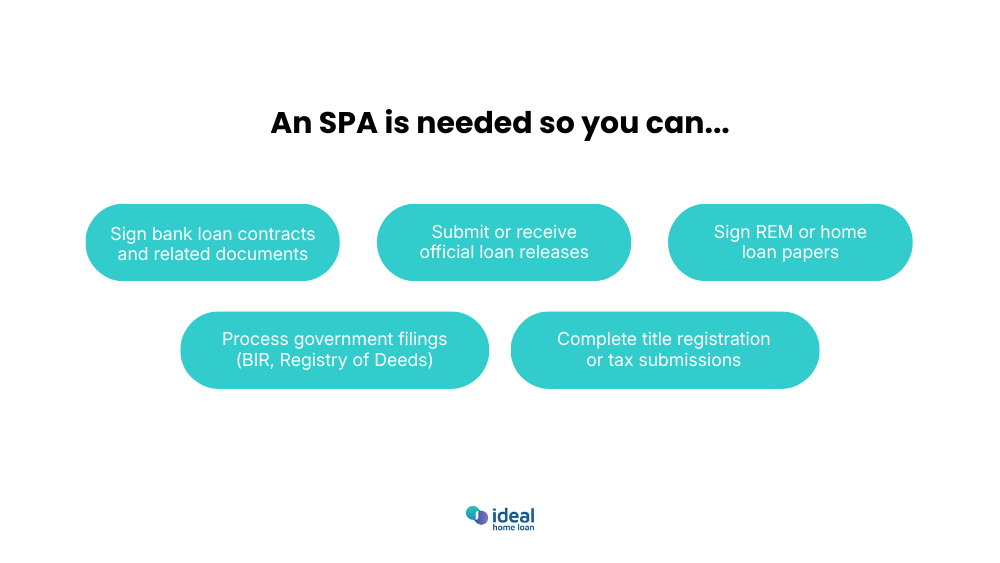
An SPA is typically needed when the principal (you) cannot appear in person to:
- Sign bank loan contracts and related documents
- Submit or receive official loan releases
- Sign REM or mortgage papers
- Process government filings (BIR, Registry of Deeds)
- Complete title registration or tax submissions
Banks and lenders have their own rules, but generally, any action involving legal authority or contract signing will trigger the need for an SPA that’s properly notarized or authenticated.
To see the step‑by‑step OFW home loan requirements, make sure to visit our OFW guide and find your document checklist here.
Who can be your Attorney-in-Fact?
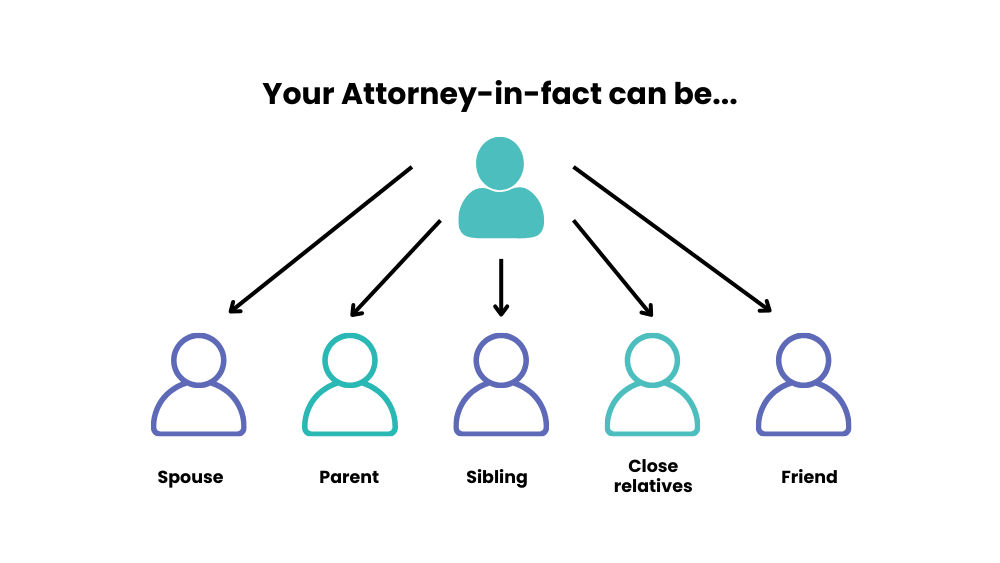
You can name nearly anyone you trust as your attorney-in-fact, including:
- Spouse
- Parent
- Sibling
- Close relatives (Uncles, Aunts)
- Friend you trust to handle financial and legal matters
The key is trustworthiness, reliability, and clear communication about what they are authorized to do.
IDEAL Tip: If you are married and the property is conjugal or community property, some banks may require spousal consent as well. Your SPA can include that, or you can prepare a separate spousal consent document.
Steps to create and notarize/consularize an SPA
Whether you are in the Philippines or abroad, here is how you can prepare and authenticate your SPA:
Draft the document Your SPA should clearly state the following:
Notarize (if in the Philippines)
If you are in the Philippines:
- Sign the SPA in front of a notary public.
- Present valid IDs.
- Notarization converts the SPA into a public instrument that’s generally acceptable for banks and government agencies.
Consularize or Apostille (if abroad)
If you’re overseas:
- The SPA needs to be notarized and consularized at the Philippine Embassy or Consulate where you are residing.
Alternatively, if the country you are in is part of the Hague Apostille Convention, you can notarize locally and then get an apostille from the competent authority. The Philippines recognizes apostilled documents.
Send the Original to the Philippines
Once notarized, send the original SPA to your attorney-in-fact or directly to the bank. Keep copies and digital scans for your records.
Common SPA mistakes that cause bank issues
Even small errors can derail your loan processing. Here are common pitfalls to avoid:
- Vague or Insufficient Powers
A generic statement like “do all necessary acts” is often rejected. Banks require specific powers, such as “authority to sign Loan Agreement, PROMISSORY NOTE, and REM.” - Wrong or Missing Property Details
If your SPA references the property, include accurate and complete property information (Title number, address, lot number). Mistakes cause delays. - Outdated or Improper Authentication
SPAs signed abroad must be consularized or apostilled to be valid. Failure to do so often leads to outright rejection. - No Spousal Consent
Banks and Pag-IBIG sometimes require spousal consent if the property is marital property. Check your lender’s requirements ahead of time. - No Validity or Expiry Clause
Technically, an SPA does not expire under the Civil Code, but banks often treat old SPAs as “stale”. Consider including a validity period and scheduling re-execution if needed.
Sample structure of an SPA (High-Level Sections)
Below is a typical structure you might see in a housing loan SPA.
Title: SPECIAL POWER OF ATTORNEY
Preamble/Recitals: Identifies principal and attorney-in-fact and states the reason for the SPA
Grant of Authority: Enlists specific actions your attorney‑in‑fact may perform (e.g., apply for loan, sign documents)
Property & Loan Details: Reference to property description and lender information (if applicable)
Validity & Duration: Effective date and any period of validity
Signatures: Principal’s signature, Attorney‑in‑fact’s signature (optional), Notary Public / Consular authentication block
Feel free to download the Special Power of Attorney (SPA) template here. Once completed, make sure it is properly notarized or consularized to ensure it is valid for your home loan application.

Read more about Home Loans
If you’re still figuring things out, that’s completely normal. Home loans come with a lot of details, especially if you’re applying while working overseas. That’s why we’ve put together more home loan articles on our website. They cover common questions we hear from buyers and OFWs every day, from understanding loan requirements to choosing between banks and Pag-IBIG. You can read them at your own pace and come back whenever you need clarity on the next step.

Frequently Asked Questions
How long is an SPA valid?
Legally, an SPA remains valid until:
- The purpose is accomplished
- You revoke
- Either party dies or becomes incapacitated
Ideal Tip: Banks often prefer SPAs signed within the last 12 months or include a clear validity period.
Can I revoke my SPA?
Yes. You can revoke an SPA any time by executing a Revocation of SPA document, having it notarized, and notifying all parties (bank, attorney‑in‑fact).
Does an SPA give ownership rights?
No. An SPA does not transfer ownership or property rights. It only authorizes actions on your behalf.
What if my attorney‑in‑fact needs to substitute someone?
Only if your SPA explicitly allows substitution. If not stated, the attorney‑in‑fact cannot appoint others.
Can I use a scanned SPA?
Banks and government offices typically require original notarized/consularized documents. Scans are useful for pre‑screening but not final submissions