Check out more of our news
2026 OFW Housing Loans Guide: Everything You Need To Know
February 18, 2026 | Read Time 15 minutes

Thinking about getting a home loan in the Philippines but feeling unsure where to start? You’re not alone. Many OFWs want to invest in a home for their family or future, but the process can seem confusing when you’re abroad. Questions about eligibility, documents, interest rates, and trusted developers often hold people back. The good news is, with the right guidance, these hurdles are easier to handle than you might think. This guide will walk you through everything you need to know about OFW home loans in 2026, so you can take the first step with confidence.
Can OFWs Really Get Home Loans in the Philippines?
YES! This is one of the most common questions we hear, and the answer is a clear yes.
Philippine banks and government institutions actively offer housing loans to OFWs. In fact, OFWs are often viewed as strong borrowers because they typically have stable incomes and long-term earning potential.
What makes OFW home loans feel difficult isn’t eligibility—it’s the distance, documentation, and lack of clear guidance. Once those are addressed properly, the process becomes much more manageable.
What Exactly Is an OFW Housing Loan?
An OFW housing loan is a loan designed for Filipinos who earn their income outside the Philippines but want to purchase or build property back home. Functionally, it works the same way as a local home loan: you borrow money, pay monthly amortizations, and use the property as collateral.
The difference lies in how banks verify your income, employment stability, and authority to transact while you’re abroad. Because lenders cannot meet you in person or verify your employer locally, they rely heavily on documents and formal authorizations.
This is also why choosing the right loan option matters.
Home Loans OFWs Can Apply For
As an OFW, you’re eligible to apply for several types of bank home loan products and many of these can be processed from abroad with proper documentation and support. Philippine banks offer a range of home loan solutions that go beyond just buying a house, so you can choose what fits your goals and financial situation best.
Primary Home Loan
This is the standard home loan for buying your first house, condo, or lot. It’s what most first-time buyers start with, and it covers a portion of the property’s purchase price.
Secondary Home Loan
If you’re buying a pre-owned or resale property, you can apply for a secondary home loan. The requirements are mostly similar to a first-home loan, but banks usually require an appraisal of the property to confirm its current market value. This is perfect if you’re looking for an affordable or move-in ready property.
Refinancing / Loan Take-Out
Already have a housing loan? You can refinance to a new loan, often to get a lower interest rate, reduce monthly payments, or adjust the loan term. Essentially, the new loan pays off your old one with updated terms.
Home Equity
If you’ve been paying off your home for a while, you can tap into its equity (the portion of your property you already own) to fund other needs. This can be a flexible option for home improvements, investments, or personal expenses, all while using your property as collateral.
💡 IDEAL Home Loan Tip: Save yourself the hassle by applying through IDEAL Home Loan. Just send us your documents once, and we’ll help submit your application to multiple banks. |
Who Is Eligible for an OFW Home Loan in 2026?
Eligibility depends on a combination of employment stability, income capacity, and documentation completeness.
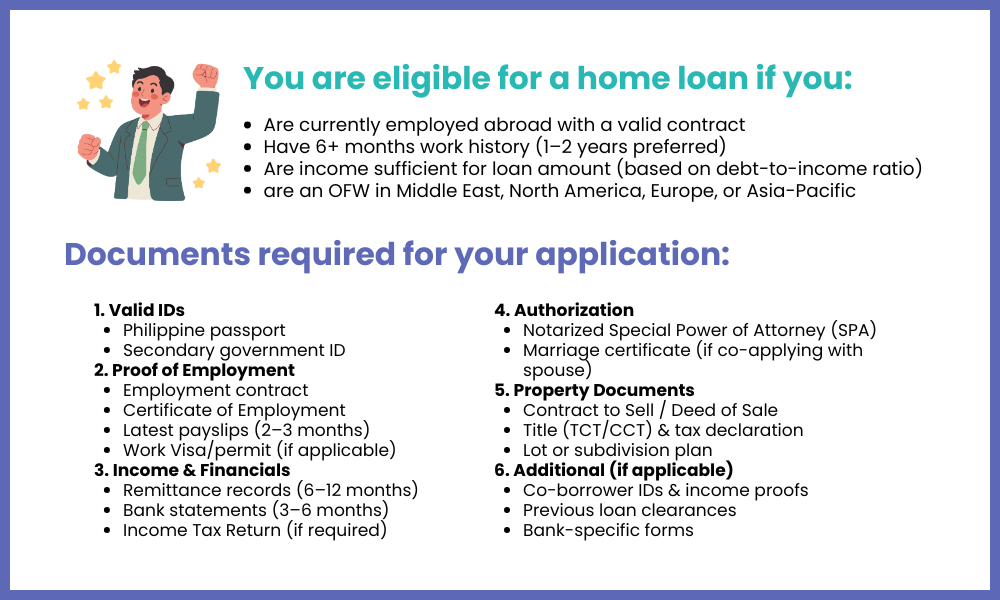
Banks generally look for OFWs who are currently employed abroad with a valid contract. While some lenders accept applicants with as little as six months of overseas work history, having at least one to two years of continuous employment significantly improves approval chances.
Income is another major factor. Your overseas salary must be sufficient to support the loan amount you’re applying for, based on the bank’s debt-to-income rules. This is why payslips and remittance records are so important.
Your country of employment also matters. OFWs working in the Middle East, North America, Europe, and parts of Asia-Pacific are widely accepted by lenders, though certain countries may require additional employment verification due to local labor laws.
The Documents You Need (And Why They Matter)
One of the biggest sources of stress for OFW borrowers is documentation. Not because the requirements are unreasonable, but because they’re often unclear or poorly explained.
Banks usually ask for valid identification, including your Philippine passport and secondary government IDs. These establish your identity and citizenship.
They will also request proof of overseas employment. This typically includes your employment contract, a certificate of employment, and recent payslips. These documents show that your income is legitimate, ongoing, and stable.
Remittance records play an equally important role. Banks want to see that your income actually makes its way to the Philippines and does so consistently. Regular remittances over the past six to twelve months are a strong positive signal.
One document unique to OFWs is the Special Power of Attorney, or SPA. Since you’re abroad, banks require written authorization allowing someone you trust to sign documents, submit requirements, and coordinate locally on your behalf. This SPA must be notarized abroad and authenticated by the Philippine embassy or consulate.
Finally, property documents are required once you’ve chosen a home. These ensure that the property has a clean title and is acceptable as loan collateral.
💡 IDEAL Home Loan Tip: Get easy access to the list of documents needed through this checklist. |
How the OFW Home Loan Process Works When You’re Abroad
Applying for a home loan while overseas sounds overwhelming until you understand the flow.
STEP 1: Get Pre‑Qualified- Know What You Can Borrow
The very first step, even before you start dreaming about a specific house or condo, is to find out how much you can realistically borrow. This is called pre‑qualification, and it’s about matching your overseas income with lenders’ rules.
Lenders look at your salary, contract, remittance history, and other financial details to estimate the loan amount you can afford. Pre‑qualification doesn’t guarantee approval, but it does prevent mistakes like falling in love with a property that’s outside your budget.
Our pre-assessment check helps you know how much you can borrow and which banks are most likely to approve you, so you can make smarter, faster decisions.
With IDEAL, you don’t have to figure this out alone. Our pre-assessment check reviews your income, obligations, and target loan so you know exactly what you can borrow. Once you’re pre-qualified, we can help submit your documents to multiple banks, saving you time and helping you find the best loan option.
STEP 2: Choose Your Property
Once pre‑qualified, it’s time for one of the most exciting parts: selecting the property you want to buy.
But you should only pick a property after you know your loan range. If you reserve a home without confirming financing first, you risk losing reservation fees or having to negotiate new terms if the bank approves a lower amount.
Many OFWs pause at this stage because they’re tempted by a good deal. That’s completely understandable, but with the right budget snapshot, you’ll choose something you can afford and that a bank is willing to finance.
STEP 3: Prepare and Organize Your Documents
This is where details truly matter. Lenders will want to see documentation that proves your identity, employment, financial stability, and the legitimacy of the property you’re buying.
For OFWs, requirements typically include things like your passport, employment contract, remittance records, and income proofs. Pag‑IBIG specifically requires an active membership and at least 24 monthly contributions. If you don’t yet have enough contributions, you can sometimes pay a lump sum to qualify.
Since you are overseas, you also need a Special Power of Attorney (SPA) that’s notarized and authenticated by the Philippine Embassy or Consulate. This lets a trusted representative in the Philippines handle tasks that require your signature.
Getting this SPA done early and before you start submitting anything, can save you weeks of delay.
STEP 4: Submit Your Loan Application
With all necessary documents prepared, the next big moment is sending in your complete loan application.
You can submit these either directly with the lender’s online portal (if available), through a representative using your SPA, or via an intermediary like IDEAL Home Loans who can coordinate everything for you.
At this point, lenders will do an initial check to ensure they have everything they need. Make sure your documents are complete and accurate to avoid delays in your application.
STEP 5: Loan Evaluation, Appraisal, and Verification
Once your application is in, the lender begins evaluation and appraisal.
For property loans, this typically includes:
- Credit and background checks to confirm your financial history
- Income and remittance verification so that the bank feels confident you can repay the loan
- Property appraisal, where the lender assesses the real market value of your chosen home
This phase usually takes several weeks, depending on the lender and how quickly you respond to any follow‑up questions.
STEP 6: Receive Loan Approval and Review the Offer
After all assessments are complete, the lender issues either a Notice of Approval (NOA) or a Notice of disapproval.
If everything checks out, the NOA will outline:
- The loan amount you’re approved for
- The interest rate and repayment terms
- Monthly amortization
- Any special conditions the lender might attach
This is your opportunity to review the terms closely. If you’re unsure about any part of the offer, ask for clarification before moving forward especially with interest rates, repricing periods, and amortization schedules.
Once you sign the approval documents (either in person via a representative or through embassy channels), you’re ready for the next stage.
STEP 7: Sign Legal Documents and Home Loan Papers
Loan approval is great news, but you still need to formalize the agreement.
This means signing mortgage documents like a Promissory Note, Real Estate Mortgage, and other legal disclosures. These agreements spell out your obligations and confirm that the lender is taking the property as collateral until full repayment.
For OFWs, this often happens through your authorized representative in the Philippines — all enabled by your consular‑authenticated SPA.
Once these documents are signed, they’re typically submitted for annotation with the Registry of Deeds so the lender’s interest is officially recorded on the title.
STEP 8: Loan Release and Turnover
After everything is legally signed and recorded, the final step is the release of funds.
The lender will send the loan amount directly to the seller or developer, not to you personally. This ensures the property transaction is completed properly and the title transfer proceeds smoothly.
Once the seller receives payment and the title is updated in your name with home loan annotation, the home is officially yours to occupy, rent, or use as you planned.
STEP 9: Post-Loan Follow-Up and First Amortization
Even after the loan is released, there are a few final things to wrap up. The bank or Pag‑IBIG will start your loan amortization schedule, and you’ll begin monthly payments on the agreed dates.
Make sure you keep records of all payments and correspondence with your lender. Staying proactive here prevents surprises and ensures your account stays in good standing.
Home Loan Interest Rates for OFWs in 2026
When you’re applying for a home loan from abroad, interest rates matter even more. A difference of just half a percent may not seem like much at first, but over 15 or 20 years, it can significantly affect your monthly payments and total cost.
For 2026, OFWs can expect bank home loan interest rates to generally fall between 4.5% and 8.35%, depending on how long the rate is fixed and which lender you choose.
To give you a clearer picture of what’s available, here’s a snapshot of current interest rate ranges offered by major banks and lenders for OFWs.
BANK/LENDER | INTEREST RATES (RANGE) |
BDO Unibank | 6.00% - 6.50% |
BPI | 6.50% |
PSBank | 7.00% - 7.50% |
MetroBank | 6.75% |
RCBC | 6.5% |
China Bank | 7.50% - 8.00% |
EastWest Bank | 5.99 - 6.49% |
HSBC | 6.56% - 6.75% |
The Types of Properties OFWs Commonly Buy
When it comes to buying property in the Philippines, most OFWs gravitate toward house-and-lot units, particularly those planning to settle with their families. According to industry surveys, about two-thirds of OFW buyers prefer horizontal properties in provincial markets like Cavite, Laguna, Batangas, and Central Luzon, where larger lots are more affordable and offer long-term value. These homes provide space, outdoor areas, and community amenities that appeal to families, making them a preferred choice for long-term living.
At the same time, condominiums remain popular, especially for OFWs looking for investment opportunities or properties that are easier to manage remotely. Condos in Metro Manila and other urban centers attract buyers seeking rental income or future liquidity, with typical units in the ₱2.5–7 million range. While condos offer convenience and city access, surveys show that OFWs still prioritize family-oriented spaces, making house-and-lot properties the dominant choice. Understanding these trends helps buyers pick a property type that fits both their lifestyle and financing options.
Common Challenges of OFWs with Housing Loans in the Philippines
Owning a home in the Philippines while working abroad is a dream for many OFWs—but the journey is rarely straightforward. Being miles away brings a unique set of obstacles that can turn what should be an exciting milestone into a stressful experience. The challenges are real but entirely manageable if you know what to watch for. Here’s a closer look at the hurdles OFWs often face:
Distance Makes Everything Harder
Trying to coordinate with banks, developers, and notaries across time zones can be exhausting. Even simple questions or document clarifications may take days to resolve, and without careful planning, the entire loan process can stretch much longer than expected.
Confusing Paperwork
Submitting the wrong documents or missing something small like an authenticated SPA or proof of remittance can quickly delay approval. OFWs often experience multiple rounds of resubmission simply because requirements weren’t clearly explained.
Trust and Security Risks
Being far from the property exposes OFWs to scams and misleading offers. Unaccredited agents or developers can take advantage of distance and lack of local oversight, sometimes resulting in serious financial or legal consequences.
Complicated Approval Steps
Banks and lenders typically have stricter verification requirements for OFWs, from income checks to property appraisals. Without guidance, it can be confusing to know what each lender expects, which slows down the process.
Missing Out on Opportunities
Delays caused by distance, paperwork, or unclear steps can lead to missed chances on prime properties or favorable loan terms. OFWs without support may find themselves frustrated or settling for less than ideal options.
This is why working with IDEAL Home Loans matters. They act as your local partner, guiding you through each step, checking documents in advance, and ensuring you only deal with legitimate banks and developers. With their support, OFWs can navigate the mortgage process confidently, even from thousands of miles away.
How to Avoid Scams and Costly Mistakes
Buying property from abroad comes with risks, but most can be avoided with careful steps:
1. Verify Before You Pay
Never send money without seeing verified documents. Promises of guaranteed approval or unusually low rates are usually red flags.
2. Check Developer Credentials
Confirm that the developer is accredited by major banks and has a clean track record.
3. Confirm Property Ownership
Make sure the title and tax records are authentic and updated—checking with the Registry of Deeds can prevent costly legal issues.
4. Ask Questions, Don’t Rush
A legitimate adviser will never pressure you. Take your time and clarify anything that’s unclear.
5. Work with a Trusted Partner
A reliable adviser like IDEAL Home Loan ensures documents are correct and connects you only with accredited banks and developers, making the process safe and smooth.
Frequently Asked Questions
1. Can OFWs apply for a home loan without going back to the Philippines?
Yes! With a notarized Special Power of Attorney (SPA), a trusted representative can submit documents, sign papers, and coordinate with banks on your behalf.
2. What documents do OFWs need to apply for a housing loan?
Common requirements include a valid passport, government-issued IDs, proof of overseas employment, remittance records, payslips, and a notarized SPA. Property documents like the contract to sell and title are also needed once a home is chosen.
3. Can OFWs buy any type of property?
Yes, though the most common choices are house-and-lot units and condominiums. Banks generally favor properties with clear titles and established developers, and lot-only purchases may require higher down payments or separate construction loans.
4. Do I need a co-borrower or co-signer?
It depends on the bank and your income. Some lenders may require a co-borrower if your income alone doesn’t meet the loan eligibility criteria. Spouses or immediate family members are commonly accepted.
5. How long does it take to get approved?
Approval timelines vary by lender, but generally range from 4 to 8 weeks, depending on the completeness of documents and property verification.
6. Are interest rates higher for OFWs compared to local residents?
Not necessarily. Many banks offer the same rates for OFWs as locals, but some lenders may have slightly higher rates due to the added complexity of verifying overseas income. Pag-IBIG loans, being government-backed, offer the same rates to OFWs and local borrowers.
7. Can I use my salary from another country as proof of income?
Yes. Banks accept foreign salaries as proof of income, but you will need official employment contracts, payslips, and sometimes remittance records to show a consistent income flow.
8. How do exchange rates impact my loan payments or remittances?
Exchange rate fluctuations can affect the peso equivalent of your foreign salary when remitting funds to pay your monthly amortization. A weaker foreign currency may reduce the amount you can send, potentially causing shortfalls if not planned. Many OFWs mitigate this by using forward remittance plans or paying through banks that offer multi-currency or fixed-rate remittance options.
9. What happens if my overseas job ends before the loan is fully paid?
If you lose your overseas income, your ability to make monthly payments could be affected. Banks may require a co-borrower or alternative proof of income. In some cases, lenders allow loan restructuring, deferment, or bridging payments if you find new employment. It’s essential to notify your bank early and explore options before missing payments.
10. Can I apply for a home loan if I already have other loans or credit abroad?
Yes, but banks will consider your total debt obligations when assessing your loan eligibility. Having existing loans or credit abroad may affect your debt-to-income ratio, so it’s important to disclose all current liabilities. Some lenders may require a co-borrower or higher down payment to offset the risk
Your hard work overseas deserves a home you can call your own. With IDEAL Home Loans by your side, you’ll have expert guidance, trusted connections, and peace of mind throughout the process. Reach out now and let’s make your homeownership dream come true!