Check out more of our news
How Do Banks Decide How Much You Can Borrow?
February 19, 2026 | Read Time 14 minutes

If you are thinking about buying your first home, one of the first questions that probably comes to your mind is, “How much home loan can I get based on my salary?”
Sounds simple, but the answer involves a few important concepts that are new for most first-time buyers. Banks do not just look at how much you earn, they also look at how your income fits into your entire financial picture.
What does “Capacity to Pay” Mean?
Capacity to pay simply means:
How much of your income can safely go toward loan payments every month?
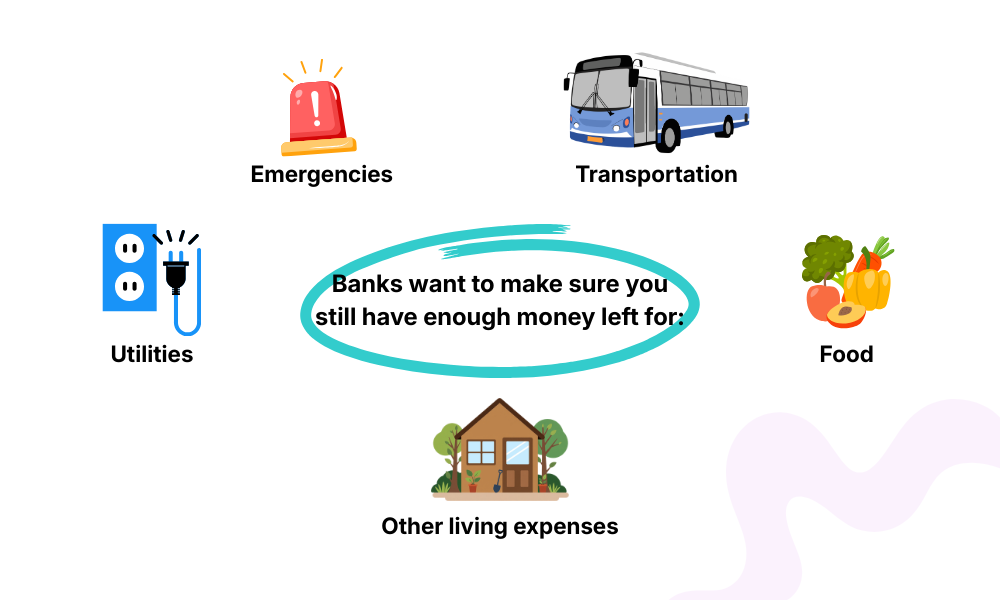
If all your income goes to loan payments, even a small problem (like job loss or illness) could cause missed payments. That’s what banks try to avoid.
How do banks compute your “Capacity to Pay”?
Let’s break down the process:
Step 1: Banks check your monthly income
Banks look at your gross monthly income. This is your income before taxes and deductions.
They verify this using documents such as:
- Payslips
- Certificate of Employment
- Income Tax Returns
- Bank statements
For OFWs, this may include:
- Employment contracts
- Remittance records
- Overseas payslips
The key thing banks want to see is your stable and regular income
Step 2: Banks list all your monthly debts
Next, banks look at all your existing monthly obligations, like:
- Car loan payments
- Credit card minimum payments
- Personal loans
- Existing housing loans
These are fixed payments that must be paid every month, no matter what. Daily expenses like groceries, electricity, or phone bills are not included in this calculation. Only formal debts. This is where most first-time buyers get confused. Let’s break it down. What is Debt-to-Income Ratio?Step 3: Banks use the Debt-to-Income Ratio (DTI)
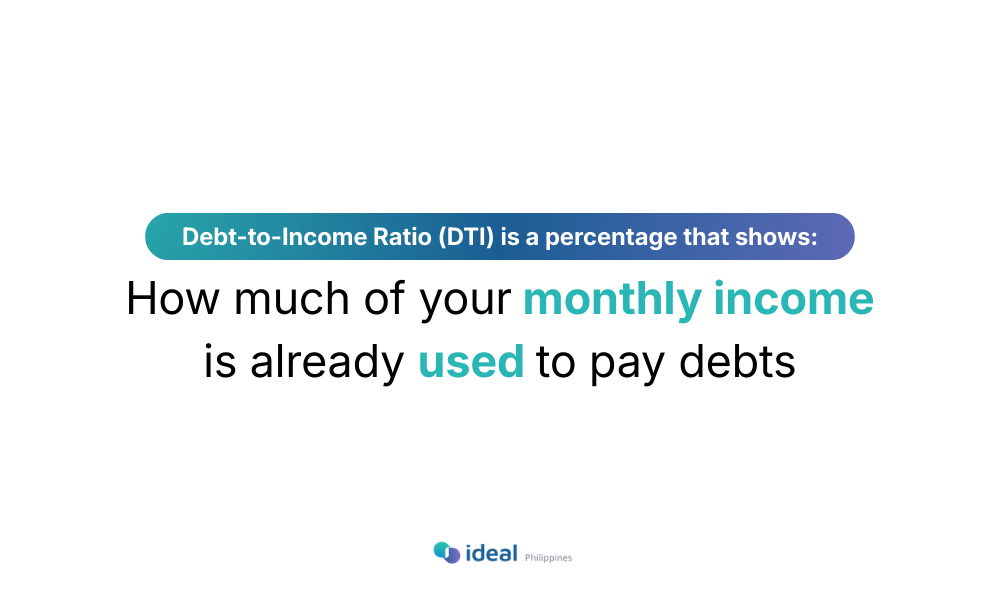
Let’s calculate your Debt-to-Income (DTI) ratio
1. Add up your monthly debts
Include all your recurring debt payments, such as home loan or rent, car loans, credit card bills, and any other loans. Do not include regular living expenses like utilities, groceries, or insurance premiums.
2. Determine your gross monthly income
Use your total pre-tax monthly income from all sources, including your salary, freelance earnings, rental income, or any other steady income you receive.
3.Use the formula to calculate your DTI
Divide your total monthly debt payments by your gross monthly income, then multiply by 100. The result is your DTI percentage, which shows how much of your income goes toward debt each month.

Let’s say that your monthly income is ₱40,000 and your total monthly debt for your car and credit card is ₱10,000
DTI = (10,000 ÷ 40,000) × 100
DTI = 25%
This means that 25% of your income already goes to debts.
Why is DTI important?
Most banks in the Philippines prefer a DTI between 30% to 35% or lower for home loan applicants.
This means:
- If your DTI is already high, you have less room for a home loan
- If your DTI is low, you can usually borrow more
How much of your salary can you use for loan payments?
Banks usually allow 30% to 40% of your income to go toward total debt payments, including the home loan.
Monthly Salary | Safe Loan Budget | Max Loan Budget |
₱30,000 | ₱9,000 | ₱12,000 |
₱50,000 | ₱15,000 | ₱20,000 |
₱75,000 | ₱22,500 | ₱30,000 |
₱100,000 | ₱30,000 | ₱40,000 |
These amounts are monthly payments, not the total loan.
The actual loan amount depends on:
- Interest rate
- Loan term (years)
- Bank policies
Not sure where you stand?
Instead of applying blindly, IDEAL Home Loan’s pre-credit assessment gives you a reality check before you submit to any bank.
We look at:
- Your basic profile
- Your income
- Your current obligations
- Your target loan amount
Then we match you with banks where you actually have a strong chance of approval.
Examples
Scenario 1: Single-Income Borrower
Maria is a young professional dreaming of her first condo. She earns ₱50,000 a month but Maria already has a few monthly obligations:
- Car loan: ₱6,000
- Credit card minimum payment: ₱2,000
That adds up to ₱8,000 in monthly debts.
Now, the bank uses a rule of thumb: you shouldn’t spend more than 40% of your income on debts.
So for Maria:
50,000 × 40% = ₱20,000
After subtracting her existing debts:
20,000 − 8,000 = ₱12,000
This means the bank will only consider ₱12,000 per month as Maria’s affordable home loan payment.
So even though she earns ₱50,000, her dream condo has to fit within a ₱12,000 monthly payment budget.
Scenario 2: Dual-Income Borrower
Juan and Anna are a married couple planning to buy a house together. Juan earns ₱40,000, and Anna earns ₱35,000, giving them a combined income of ₱75,000.
They also have some debts to juggle:
Car loan + credit card payments: ₱10,000
Using the same 40% rule, the bank calculates:
75,000 × 40% = ₱30,000
Subtracting their existing debts:
30,000 − 10,000 = ₱20,000
With two incomes, Juan and Anna can afford a ₱20,000 monthly home loan payment.
Sharing income with a co-borrower can dramatically increase your loan capacity, making bigger or more comfortable homes possible.
How does existing debts reduce your Loan Amount?
Every peso you owe monthly reduces how much you can borrow.
Type of Debt | Counts in DTI? | Why It Matters |
Credit cards | Yes | High interest, ongoing |
Car loans | Yes | Fixed long-term |
Personal loans | Yes | Monthly obligation |
Utilities | No | Variable expenses |
Even a small credit card balance can limit your loan if the monthly minimum payment is high.
How can you improve your borrowing power?
If your current salary does not qualify you for your target home, here are practical steps:
1. Pay off small debts first
Clearing credit cards or short-term loans lowers your DTI immediately.
2. Choose longer loan terms
Longer terms means lower monthly payments (but higher total interest)
3. Add a Co-Borrower
A spouse or family member with income can significantly increase loan eligibility
4. Declare all legitimate income
Side income can help if properly documented
5. Improve credit behavior
Paying bills on time builds trust with lenders
How OFW income is assessed
OFW income is assessed differently, but the same principles apply.
Banks usually consider:
- Converted income in PHP
- Contract duration
- Proof of remittances
- Employment stability
Short contracts or irregular income may reduce approved loan amounts.
Understanding how salary affects your home loan is one of the most important first steps in your home-buying journey. It’s normal to feel overwhelmed by terms like DTI, capacity to pay, or loan limits, but at its core, the idea is simple:
Banks want to know how much you can comfortably pay every month without putting your finances at risk.
Your salary, existing debts, and income stability all work together to determine what you can realistically afford. Knowing these limits early helps you set a realistic budget, avoid loan rejections, choose properties that truly fit your financial situation, and plan confidently instead of guessing.
To get a clearer picture of your own affordability, you can use our Home Loan Calculator. It helps you quickly estimate your possible monthly payments and loan range based on your income and existing obligations, giving you a practical starting point before submitting your application.
If you’re ready to go deeper and want a full roadmap, we also recommend reading our 2026 Complete Home Loan Guide: Plan Your Journey to Owning a Home in the Philippines. This guide walks you through the entire process, from preparation and loan requirements to approval, fees, and long-term planning.
Ready to start with your application?

Frequently Asked Questions
How much salary do I need to qualify for a home loan?
There is no fixed minimum salary for a home loan. Banks usually look at your monthly income compared to your debts. As long as your income can support the monthly loan payment while keeping your debt-to-income ratio within limits, you may qualify.
Is a higher salary always better for home loan approval?
Not always. A high salary with high existing debts can still lead to loan rejection. Banks care more about how much of your income is free for loan payments, not just how much you earn.
Can I get a home loan if I already have a car loan?
Yes. Having a car loan does not automatically disqualify you. However, the car loan’s monthly payment will be included in your DTI, which may reduce the home loan amount you qualify for.
Do credit cards affect home loan approval?
Yes. Even if you pay your credit card in full sometimes, banks usually count the minimum monthly payment as part of your debt. High credit card balances can significantly lower your loan capacity.
Is rent included in debt-to-income ratio?
Yes, in many cases. If you are paying rent regularly, banks may include it when computing your overall obligations, especially if you plan to keep renting while paying the home loan.
Does length of employment matter for home loan approval?
Yes, most banks prefer borrowers who have been employed for at least 1-2 years or have a stable income history. Longer employment suggests more income stability.
Can bonus or allowances be included in salary computation?
Some banks include bonuses and allowances, but usually only if they are regular and documented. One-time or inconsistent bonuses may not be counted.