Check out more of our news
Your Ultimate Home Loan Requirements Guide (For Locals & OFWs)
February 13, 2026 | Read Time 17 minutes

Getting a home loan in the Philippines can be simpler than you think when you know what documents to prepare and how to organize them. No matter if you’re employed in the Philippines, running your own business, or working abroad as an OFW, this guide shows exactly what documents you need and how to keep everything on track. Plus, you can use our printable checklist to stay on top of everything!
Requirements for Locally Employed Applicants
For individuals employed locally, home loan lenders primarily assess stability of employment and proof of consistent income. They also require personal identification and property documentation. Preparing these documents carefully avoids last-minute issues during the loan process.
Personal Identification
Personal identification is critical to verify your identity and legal status. Lenders typically require at least two (2) valid government-issued IDs. Some of these include:
☑️ Passport - Valid for at least six (6) months
☑️ Driver’s License - Must be current and government-issues
☑️ SSS, GSIS, or PRC ID - Official IDs recognized for verification
☑️ Tax Identification Number (TIN) - Required for all financial transaction
☑️ Community Tax Certificate (Cedula) - Confirms residence and personal details.
Tips for Applicants:
|
Income Documents
Lenders assess your capacity to repay the loan based on your stability, consistency, and creditworthiness, all of which can be evaluated through formal income records.
Common requirements include:
☑️ Income Tax Return (ITR) - Usually the last 2-3 years. This proves consistent income over time.
☑️ Certificate of Employment (COE) - Must indicate position, monthly salary, and length of employment.
☑️ Payslips - Last 2-3 months to verify current income.
☑️ Bank Statements - Last 3-6 months showing regular salary deposits
For those with bonuses or commission-based income, it is helpful to include proof of average annual earnings to strengthen your loan application.
Tips for Applicants:
|
Property Documents
Property documents validate the asset being financed. Requirements typically include:
☑️ Reservation Agreement or Contract to Sell - Confirms your intent to purchase
☑️ Transfer Certificate of Title (TCT) or Condominium Certificate of Title (CCT) - Conforms ownership and legal status of the property
☑️ Latest Real Property Tax Receipt - Demonstrates that taxes are paid and current.
☑️ Latest Tax Declaration - Indicates property value and ownership.
Lenders may also request lot plans, floor plans, or HOA clearance for certain properties.
Tips for Applicants:
|
Special Documents
Certain documents are required depending on personal circumstances or if a representative will handle the loan process:
☑️ Marriage Certificate - Required for joint loans or verification of marital status.
☑️ Special Power of Attorney (SPA) - Needed if someone else is processing the loan on your behalf.
☑️ Authorization Forms - For credit investigation and verification purposes.
Tips for Applicants:
|
Requirements for Self-Employed Applicants
Personal Identification
Similar to locally employed applicants, self-employed borrowers must submit valid government-issued IDs to verify identity and legal status. Commonly accepted IDs include:
☑️ Government-issued IDs - Passport, Driver’s License, SSS, GSIS, PRC ID
☑️ Tax Identification Number (TIN) - Required for all financial and tax-related transactions
☑️ Community Tax Certificate (Cedula) - Confirms residence and taxpayer details
These documents must contain up-to-date information and consistent personal details.
Tips for Applicants:
|
Income and Business Documents
Lenders place significant emphasis on business-related financial documents because these reflect your income stability. The common requirements include:
☑️ Income Tax Returns (ITR) – Last 2–3 years, showing declared business revenue and taxable income. Consistent filings demonstrate stable operations.
☑️ Audited Financial Statements (AFS) – Required for corporations or partnerships. Must be certified by a licensed CPA and preferably stamped “received” by the BIR.
☑️ Statement of Accounts / Bank Statements – The last 6 months of bank statements showing revenue deposits, operational expenses, and business cash flow.
Business Registration Documents
☑️ DTI Certificate for sole proprietorships
☑️ SEC Registration for corporations or partnerships
☑️ Mayor’s Permit / Business Permit to prove the business is legally operating
☑️ General Information Sheet (GIS) for corporations
Providing complete and accurate financial documents increases your chance of approval by giving lenders a clearer picture of your revenue patterns and business health.
Tips for Applicants:
|
Property Documents
Self-employed applicants must also submit standard property documents to verify ownership, property condition, and eligibility for mortgage financing. These include:
☑️ Reservation Agreement or Contract to Sell – Provided by the developer or seller, confirming your intent to purchase
☑️ Transfer Certificate of Title (TCT) or Condominium Certificate of Title (CCT) – Confirms legal ownership and ensures the property is clean and free from legal issues.
☑️ Latest Real Property Tax (RPT) Receipt – Ensures that the property’s taxes are paid and updated.
☑️ Latest Tax Declaration – Indicates property classification, value, and registered owner.
Depending on the property type and location, lenders may also require lot plans, floor plans, subdivision clearances, or HOA certificates.
Tips for Applicants:
|
Special Documents
Self-employed applicants may also be required to provide additional documents depending on their business structure:
☑️ Special Power of Attorney (SPA): Required if a representative will process the loan on your behalf. Must be notarized and follow a bank-specific format.
☑️ Marriage Certificate: Needed for married borrowers, especially for conjugal property considerations or spousal consent.
☑️ Board Resolution (for corporations): Authorizes the specific person (usually the business owner or an officer) to apply for the loan and sign documents on behalf of the company.
Tips for Applicants:
|
Requirements for OFWs (Overseas Filipino Workers)
Overseas Filipino Workers (OFWs) face unique challenges when applying for a home loan, primarily because they are abroad and cannot directly submit documents or attend in-person bank processes. Home loan lenders in the Philippines require additional documentation to verify identity, employment, income, and authorization, while ensuring smooth communication between the applicant and their Philippine-based representative.
Personal Identification
OFWs must provide valid identification to confirm identity and legal status:
☑️ Passport - Must be valid for at least six (6) months. This is essential for identity verification and as proof of overseas residence.
☑️ Tax Identification Number (TIN) - Needed for all financial transactions in the Philippines.
Income and Employment Documents
Home loan lenders need proof of overseas employment and financial stability to assess repayment capacity. Required documents include:
☑️ Employment Contract - Confirms position, salary, employment terms, and tenure abroad.
☑️ Certificate of Employment and Compensation - Issued by your foreign employer, verifying current salary and employment status
☑️ Payslips – Last three (3) months, showing salary deposits.
☑️ Bank Statements – Last six (6) months, showing consistent salary remittances.
Property Documents
The property documents for OFWs are the same as for local applicants:
☑️ Reservation Agreement or Contract to Sell – Confirms your intent to purchase.
☑️ Transfer Certificate of Title (TCT) or Condominium Certificate of Title (CCT) – Verifies ownership and legal status of the property.
☑️ Latest Real Property Tax (RPT) Receipt – Shows property taxes are current.
☑️ Latest Tax Declaration – Indicates property value and registered owner.
Special Documents
OFWs must provide additional documents to authorize a representative in the Philippines and comply with the requirements:
☑️ Special Power of Attorney (SPA) – Notarized locally and consularized abroad, granting authority to a representative for loan processing.
☑️ Marriage Certificate – Required for spousal consent, joint applications, or verification of marital status.
☑️ Birth Certificates – For dependents, if applicable, or for family declaration purposes.
☑️ Power of Attorney (POA) – Authorizes the representative to submit, sign, and process documents on your behalf.
Practical Tips for OFWs:
|
Overview
To help you compare requirements at a glance, the table below provides a side-by-side overview of the documents needed for locally employed, self-employed, and OFW home loan applicants.
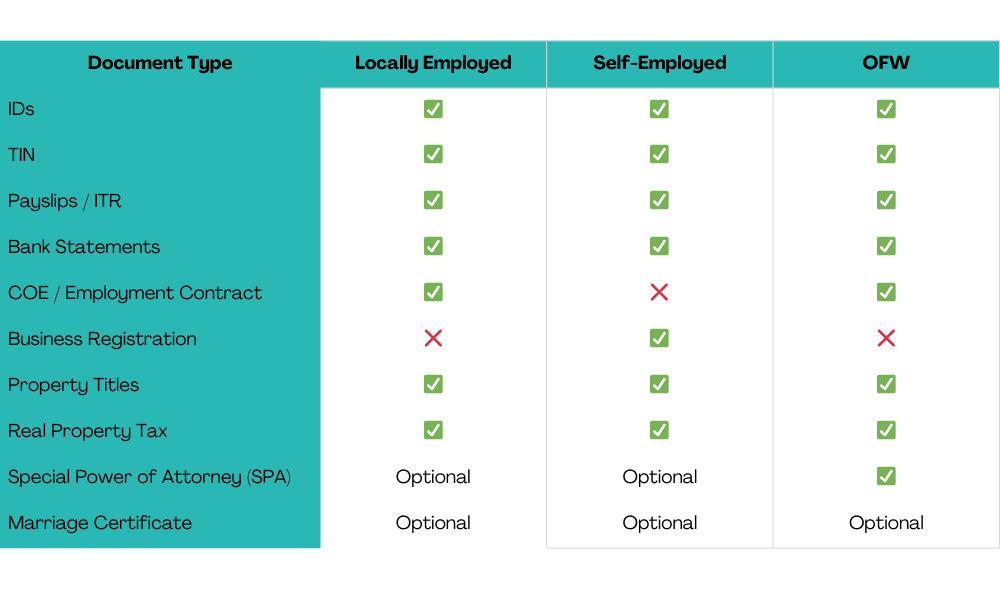
7 Tips to organize documents to avoid delays
Applying for a home loan involves a lot of paperwork, but a few smart strategies can make the process much smoother. Here’s how to stay on top of everything:
- Use a logical folder system
Group your documents by type: IDs, income proofs, property papers, and special documents. Within each folder, arrange files chronologically or by importance. This makes it faster to locate anything your housing loan lender requests. - Label everything clearly
For digital requirements, give each document a descriptive title. (such as COE_JuanDelaCruz_Jan2026.pdf). Clear labeling prevents confusion, especially when handling multiple files at once. - Use color-coding
Assign colors to different document types—blue for IDs, green for income proofs, yellow for property papers. Visual cues make it easier to grab what you need quickly. - Keep both digital and physical copies
While a few digital copies can speed up initial submission, having organized printed copies ensures you’re ready for in-person verification or last-minute requests. - Note important dates and expirations
Keep track of expiration dates for passports, IDs, or COEs. Marking these on your checklist or folder prevents delays caused by outdated documents. - Create a quick reference checklist
Maintain a simple list of every document submitted, along with notes on verification or follow-ups. This acts like a “map” of your application and makes it easy to see what’s done and what’s pending. - Track submission and communication
Using your checklist, record when and how each document was submitted and any responses from the bank. This prevents repeated requests and confusion.
We prepared a special checklist for you!
Here are your downloadable home loan requirement checklists, designed to make the entire process easier and more organized. Each checklist is structured for quick reference, easy printing, and hassle-free tracking, so you always know what you’ve already submitted and what still needs your attention.
 |  |  |
FAQs About Common Missing Documents
Q: What happens if I forget to include a required ID?
A: Lenders typically require at least two valid government-issued IDs. If you submit fewer or the IDs are expired, your application may be put on hold until the missing documents are provided.
Q: Can I submit partial income documents if some are missing?
A: Submitting incomplete income documentation like missing payslips, ITRs, or bank statements can slow down processing. Lenders need a consistent record to verify your repayment capacity.
Q: What if my Transfer Certificate of Title (TCT) is still being processed?
A: Banks may accept the latest Tax Declaration and proof of ownership temporarily. Final approval may require the TCT.
Q: Can OFWs apply without Special Power of Attorney (SPA)?
A: Initial application may proceed online, but processing in the Philippines typically requires a SPA.
Q: What if I don’t have an Income Tax Return (ITR)?
A: Self-employed applicants may submit audited financial statements, official receipts, or bank statements as proof of income.
Q: How long do banks keep documents?
A: Usually until loan approval and post-disbursement verification.
Make Your Dream Home A Reality
Navigating the home loan process can feel overwhelming, but IDEAL Philippines makes it easier. We guide you through every step, help you organize your documents, and show you loan options that best fit your financial goals. For a complete, step-by-step walkthrough of home loans in the Philippines, check out our Complete Guide to Home Loans in the Philippines, which complements everything covered here.
With IDEAL by your side, taking the first step toward your dream home has never been easier.