Check out more of our news
2026 Complete Home Loan Guide: Plan Your Journey to Owning a Home in the Philippines
February 13, 2026 | Read Time 20 minutes

A Home Loan Is Your Vehicle to Homeownership
Buying a home can feel like embarking on a long road trip. You have a destination in mind, but the journey requires preparation, planning, and the right vehicle. Most Filipinos rely on housing loans (also called mortgages) to turn the dream of homeownership into reality. A home loan provides the funds to buy, build, or renovate a property, and you repay it over time through monthly installments.
Just as you wouldn’t start a trip without checking your car, fuel, and route, you shouldn’t apply for a housing loan without understanding your options, eligibility, documents, and costs. This guide walks you through everything: from the types of loans to eligibility, step-by-step application processes, fees, sample computations, and FAQs, so you can reach your dream home smoothly.
What are the types of house loans?
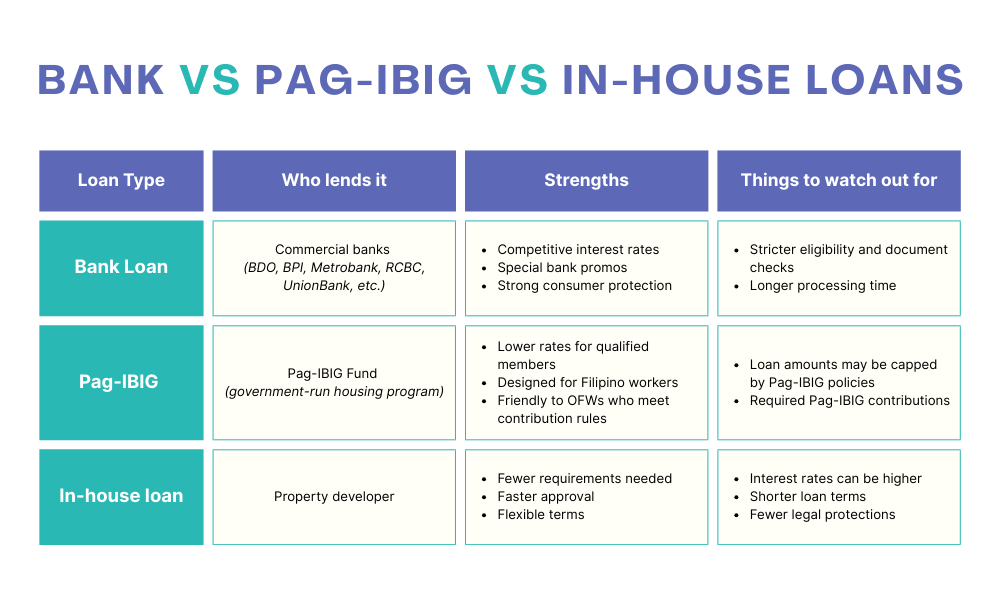
There are three main types of home loans in the Philippines, each like a different vehicle with its own personality and advantages:
Bank Loans
Bank loans are reliable and often offer competitive interest rates with long repayment terms. However, the application process is strict, and preparing all the required documents can take time. These loans are best suited for borrowers with stable income, a clean credit history, and a higher budget for property.
Some banks that offer housing loans in the Philippines include BDO Unibank (BDO), Bank of the Philippine Islands (BPI), Metrobank, Philippine National Bank (PNB), Rizal Commercial Banking Corporation (RCBC), and Security Bank Corporation. Each bank provides different interest rates, repayment terms, and requirements, giving homebuyers several options to match their financial situation and property goals.
Pag-IBIG Housing Loans
Pag-IBIG loans are government-backed and friendly for OFWs and regular contributors. They have lower interest rates and longer terms, making them ideal for first-time buyers. However, there are contribution rules and maximum loan limits, which may restrict higher-end property purchases.
In-House or Developer Financing
In-house financing is fast and convenient. The developer provides the loan directly, making it ideal for those who may not qualify for bank or Pag-IBIG loans. The downside is higher interest rates and shorter repayment periods.
Are you eligible for a home loan?
Preparing for the road trip
Before lenders approve a housing loan, they need to ensure you’re ready for the financial journey. Think of eligibility checks as your “vehicle inspection” before the road trip. Here’s what they typically look at:
1. Age
Most lenders require you to be at least 21 years old. They also want the loan to be fully paid before you hit around 70. This is not because they don't trust older borrowers but it is about risk and ensuring you can comfortably make payments until the end of the loan term.
2. Income
Lenders will check that your monthly income is enough to cover your loan payments and your living expenses. They want to be sure you won’t end up choosing between paying your loan and buying groceries.
3. Employment
Stability matters. Lenders prefer borrowers who have been in the same job or running a business for at least 1-2 years. OFWs, freelancers, and self-employed applicants may need extra documents to prove income consistency, like contracts or bank statements.
4. Credit & debts
Lenders peek at your credit record to see if you pay your bills on time and whether you already have other loans. Imagine your monthly income is a pie; lenders want to make sure your loan slice doesn’t take up almost the whole pie. A clean credit history and manageable debt make lenders confident they won’t “lose their money slice”.
5. Pag-IBIG special requirement
If you’re applying for a Pag-IBIG housing loan, there’s an extra requirement: you must have at least 24 monthly contributions, or the equivalent in a lump sum. This is Pag-IBIG’s way of rewarding members who’ve been consistently contributing, ensuring you’re committed and financially disciplined.
Documents checklist
Packing for the trip!
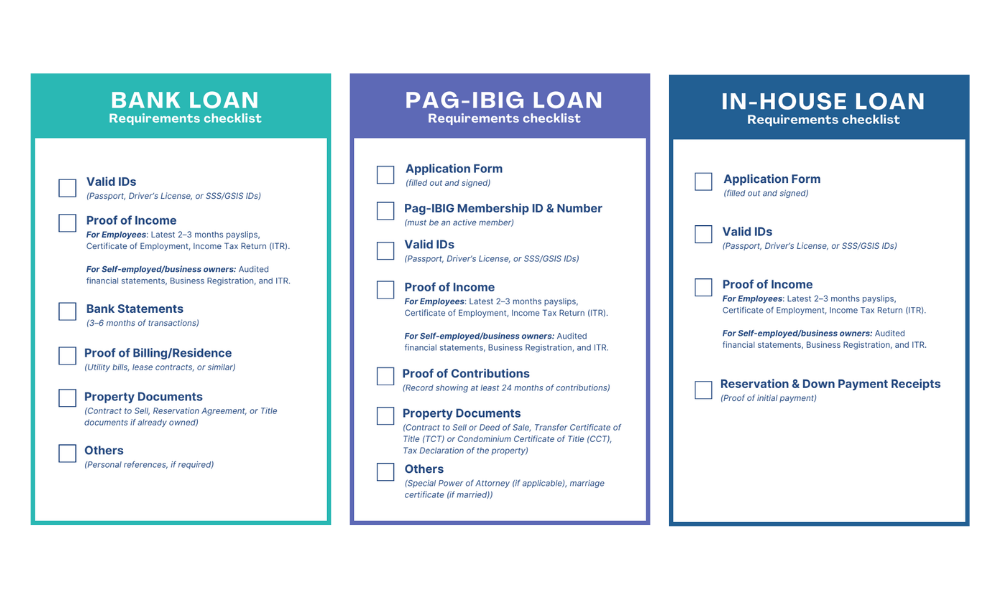
Gathering documents is like packing for a journey—the more prepared you are, the smoother the ride. Here are some of the common requirements for when you are applying for a housing loan. Save this checklist to keep your application organized and stay one step ahead on your journey to homeownership.
Step-by-Step Housing Loan Process
Following the Road Map
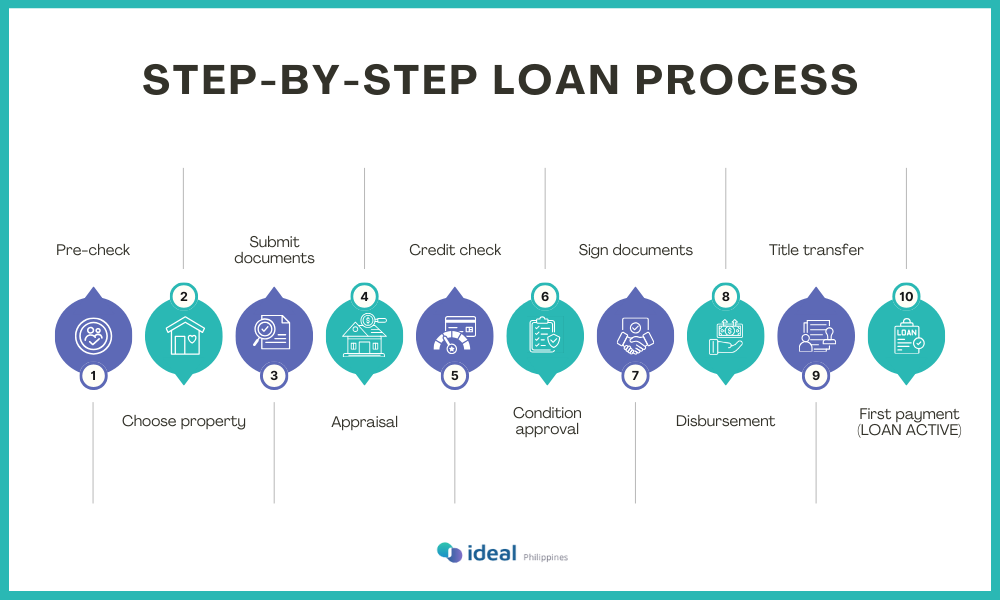
Getting a housing loan can feel like navigating a maze, but it’s predictable if you follow these steps:
- Pre-Check your budget – Know what you can afford without straining your finances.
- Choose a property & compare lenders – Like selecting the best vehicle for your trip.
- Submit application & documents – Ensure everything is accurate and complete.
- Appraisal – Lenders verify the property’s value.
- Credit check and Verification – Credit, employment, and property documents are checked.
- Conditional approval – You get a “green light” pending final checks.
- Signing loan documents – Officially commit to the journey.
- Disbursement – Funds are released to the seller or previous loan.
- Title transfer & Mortgage annotation – Legal ownership is confirmed.
- First monthly payment begins – Start your repayment journey.
Fees and charges: What are these and who pays?
When you get a home loan, there are several fees you need to prepare for. Think of these as your fuel or toll fees for your trip—you’re paying for services that make the loan happen smoothly. Most of these fees are the borrower’s responsibility.
Loan and Insurance Fees
|
Appraisal Fee |
Mortgage Redemption Insurance (MRI) |
Fire/Property Insurance |
|
|
What it is |
This is the cost to have a professional evaluate your property and confirm its market value |
Insurance that pays off your loan in case of untimely death |
Insurance that covers damage to your property due to fire, natural disasters, or accidents. |
|
Why it matters |
Lenders want to make sure they are not only lending more than your home is worth |
Protects your family from being burdened with the remaining loan balance. |
Lenders require it to protect the collateral they are lending against |
|
Where to pay |
Direct to lender |
Direct to lender or the insurance provider |
Direct to lender or the insurance provider |
Taxes & Government Fees
- Documentary Stamp Tax (DST): Tax on legal documents such as the loan contract. Usually 1.5% of the loan amount.
Where to pay: Bureau of Internal Revenue (BIR)
- Registration/Annotation Fee: Cost of registering the mortgage at the Land Registry. Ensures the lender has a legal claim on the property until the loan is fully paid.
Where to pay: Local Registry of Deeds where the property's title is registered.
- Transfer Taxes (if applicable): Paid when the property changes ownership.Typically 0.5-0.75% of the property value.
Where to pay: Local Treasurer’s Office
Processing and Miscellaneous Fees
- Processing Fee: Charged by the lender for handling your loan application. Usually 0.25%-0.5% of the loan amount.
- Notary / Courier / Other small fees: Small but important charges for document notarization, sending papers, or securing official certificates.
Common Reasons for Home Loan Rejection
Roadblocks to Watch Out For
Getting a home loan is a lot like preparing for a long road trip. It’s all about having a reliable vehicle and a full tank. Lenders want to be sure they’ll get their money back safely. They check your income, credit, existing debts, documents, and the property itself just like how you inspect the car, check the route, and ensure you have enough fuel before you hit the road.
Here are some of the common reasons why home loan applications get rejected:
- Unstable or Insufficient Income: If your income can’t comfortably cover your monthly amortization along with your living expenses, lenders may say no. Make sure your finances are steady before applying.
- High Existing Debts: Too many loans or credit card balances can signal to lenders that you might struggle with additional payments. Keep your debt under control.
- Poor Credit History: Missed payments, defaults, or previous loan rejections can raise red flags. A clean credit record will help your application shine.
- Problematic Property Title: Any legal issues, disputes, or unpaid taxes on the property you want to buy can block approval. Make sure the property is clear before applying.
- Incomplete or Inaccurate Documents: Missing IDs, payslips, ITRs, or inconsistent information can slow things down—or even get your application rejected. Double-check everything before submitting.
- Inactive Pag-IBIG membership (for Pag-IBIG Loan): You need at least 24 monthly contributions to qualify, so make sure your membership is active.
By keeping these points in mind, you can avoid common pitfalls and increase your chances of getting approved for your dream home.
Which Loan is Right for You?
Pag-IBIG vs Bank vs In-House
Choosing a home loan is like picking the right vehicle for your road trip: each option gets you to your destination, but some are faster, cheaper, or more comfortable depending on your needs. Let’s compare the three main types of home loans in the Philippines so you can see which fits your style.
Pag-IBIG Housing Loan
- Best For:
Regular Pag-IBIG contributors (including OFWs)
Borrowers looking for affordable interest rates and long repayment terms.
- Key features:
Interest rates: Generally low (around 6-8% for current rates, depending on term).
Loan term: Up to 30 years, which makes monthly payments smaller and easier to manage
Loan amount: Capped based on Pag-IBIG rules
|
Pros |
Cons |
|
|
Bank Loans
- Best For:
Borrowers with stable employment or business income.
Those with strong credit history and complete documents.
- Key Features:
Interest rates: Competitive, often starting around 6–9% depending on the bank and your creditworthiness.
Loan term: Up to 25 years; higher amounts are possible compared to Pag-IBIG.
Flexibility: Some banks allow partial prepayments without penalties, or refinancing options.
Pros | Cons |
- Can borrow higher amounts, suitable for more expensive properties. - Flexible payment options and loan structures. - Faster amortization calculators and online banking tools available. | - Strict eligibility rules: good credit history, stable income, proper documents. - Processing can take longer, sometimes 1–2 months. - Slightly higher monthly payments than Pag-IBIG for similar property value. |
In-House / Developer Financing
- Best For:
Buyers who want a quick, hassle-free process.
Those who may not meet bank or Pag-IBIG requirements.
- Key features:
Approval: Fastest among the three; can be done in days or a few weeks.
Interest rates: Higher than banks or Pag-IBIG, usually around 8–12%.
Loan term: Shorter, typically 3–10 years.
|
Pros |
Cons |
|
|
12 Tips to improve chances of approval
The better you plan, pack, and check your vehicle, the smoother your journey to homeownership will be. Here are 10 practical tips to help ensure you reach your destination without delays or detours:
💡Check your budget first
Before starting your home loan journey, calculate your monthly income versus expenses. Know what you can comfortably pay for monthly amortizations without compromising daily needs. Lenders prefer borrowers who are financially prepared and won’t overextend themselves.
💡Reduce existing debts
Clear any financial baggage before applying for a home loan. Paying off credit cards, personal loans, or other debts lowers your Debt-to-Income (DTI) ratio and increases your chances of approval.
💡Maintain stable income
A steady job or consistent business income is crucial when applying for a home loan in the Philippines. Lenders look for 1–2 years of stable income, and OFWs should show reliable remittance records. A steady income proves you can handle monthly mortgage payments.
💡Clean up your credit history
A good credit report is like a well-tuned car. Pay bills on time, settle overdue accounts, and correct any errors in your credit report. Lenders are more likely to approve applicants with a clean financial history.
💡 Prepare complete & accurate documents
Missing paperwork can stall your housing loan application. Organize IDs, payslips, bank statements, and property documents in advance. Complete documentation ensures your mortgage process is smooth and hassle-free.
💡Consider a Co-Borrower/Guarantor
Bringing a co-borrower is like traveling with a reliable buddy. Combining incomes improves repayment capacity and increases the likelihood of approval, especially for higher loan amounts.
💡Increase Pag-IBIG contributions
Extra contributions show commitment and strengthen your eligibility for a Pag-IBIG housing loan.
💡Get pre-approval
Getting a pre-approval sets your budget and shows sellers and lenders that you’re a serious homebuyer. Knowing your approved loan amount also helps you plan your property search efficiently.
💡Avoid big financial changes before applying
Don’t suddenly change jobs, take new loans, or make large purchases. Sudden changes are like taking a detour on your planned route. They can confuse the lender and slow your approval.
💡Be honest and transparent
Accurate information is your navigation system. Lenders cross-check details, so hiding debts or inflating income is like falsifying your map which can lead to rejection.
💡Save for additional fees
Budget for extra costs such as appraisal fees, mortgage redemption insurance (MRI), fire/property insurance, documentary stamp tax, and registration fees. Being prepared ensures a smoother housing loan process.
💡Choose the right lender
Compare Pag-IBIG, bank, and in-house financing options. Each has different interest rates, repayment terms, and requirements. Pick the lender that best fits your budget and timeline.
Frequently Asked Questions
Buying a home is one of the most important financial journeys you will take, and understanding housing loans is like knowing the route, fuel stops, and rules before a long road trip. Below are the most common questions about housing loans in the Philippines, explained in detail so you can travel confidently toward your dream home.
What is a Housing Loan?
A housing loan is money borrowed from a financial institution, Pag-IBIG Fund, or sometimes directly from a property developer (in-house financing) to purchase, construct, or renovate a property. You repay this loan over a set period, usually in monthly installments, which include the principal amount and interest.
The goal of a housing loan is to allow individuals to invest in a property without needing the full cash upfront. Depending on the lender, you may also be able to finance additional costs such as legal fees, insurance, and taxes
Who can apply for a housing loan in the Philippines?
Most housing loans in the Philippines are available to:
- Filipino citizens: Single professionals, married couples, or any individual with the legal capacity to enter into contracts.
- OFWs (Overseas Filipino Workers): Many banks and Pag-IBIG programs offer financing specifically for Filipinos working abroad.
- Joint borrowers: Couples or family members can apply together to increase loan eligibility.
Applicants generally need to meet age requirements—usually between 21 and 65 at the end of the loan term—and have sufficient income to cover monthly payments. Think of this as ensuring your vehicle can make the journey safely; the lender wants to be confident you can complete the trip without breaking down financially.
How much can I borrow?
The amount you can borrow depends on three main factors:
- Your monthly income: Lenders typically cap your monthly amortization at 30–40% of your gross income.
- Property price: Banks usually lend up to 80% of the property value, Pag-IBIG can lend up to 90%, and in-house financing terms vary.
- Debt-to-income ratio: Existing loans, credit cards, or other obligations reduce the maximum loanable amount.
For example, if your monthly income is ₱50,000, lenders may allow a monthly amortization of around ₱15,000–20,000. This ensures you have enough income left for daily expenses, like fuel and toll fees, without overextending yourself.
|
Monthly Income (PHP) |
30% of Income (Safe Minimum Amortization) |
40% of Income (Maximum Comfortable Amortization) Monthly income x 0.40 |
|
50,000 |
15,000 |
20,000 |
|
60,000 |
18,000 |
24,000 |
|
70,000 |
21,000 |
28,000 |
Calculate your home loan and monthly payments instantly through our home loan calculator.
Can foreigners apply for housing loans in the Philippines?
Foreigners can apply for housing loans in the Philippines, but there are important limits. Under Philippine law, foreigners generally cannot own land, so house-and-lot properties are off-limits unless the land is under a Filipino spouse or co-borrower. However, some developments offer house-and-lot or townhouse units under acondominium title, making them eligible for foreign ownership. Foreigners can also directly purchase condominium units, and some banks and programs specifically offer loans for these properties
To qualify, lenders usually require a valid long-term visa or residence permit, proof of stable income (local or abroad), a local tax identification number (TIN), and other documents similar to those needed by Filipino borrowers.
What documents are required for OFWs?
Overseas Filipino Workers have additional requirements to ensure lenders can assess repayment capability:
- Valid employment contract with your overseas employer
- Proof of remittance (bank statements or remittance receipts)
- Local bank account for payment processing
- Sometimes a local co-borrower or guarantor to support the loan
Think of it as checking your international travel documents before leaving the country. You need extra verification to make sure your journey abroad is recognized and supported.
If I’m abroad, can I still apply for a Pag-IBIG housing loan?
Yes, OFWs living abroad are eligible. What matters is that you maintain an active Pag-IBIG membership and have made at least 24 monthly contributions (or paid in lump sum). For overseas members, contributions can be remitted via Pag-IBIG’s overseas payment/remittance partners so you stay “active.”
You (or a trusted representative) may need to submit additional paperwork: a Special Power of Attorney (SPA), sometimes consularized if executed abroad, to allow someone in the Philippines to handle application steps.
What if I don’t have 24 months contributions yet, can I still apply later?
Yes, you can still apply for a housing loan by paying the remaining months as a lump sum directly to Pag-IBIG to meet the minimum requirement, or you can continue paying monthly and apply later once you hit the 24-month mark.
Can I pay off my loan early?
Yes, but it depends on the lender. Banks usually allow partial prepayments or full early settlement, sometimes with minimal penalties. Pag-IBIG on the other hand, allows early repayment, both partial and full, and generally WITHOUT prepayment penalties. While for In-house loans, terms for prepayment may vary depending on the developer.
What happens if my loan application gets rejected?
If your loan is declined, you can:
- Reapply after fixing issues (credit score, income, documents)
- Try another lender (banks have different policies)
- Add a co-borrower
- Adjust your loan amount
Can I have multiple housing loans at the same time?
Yes, but there are important considerations. Lenders will evaluate your Debt-to-Income (DTI) ratio to ensure that your combined monthly obligations—including existing mortgages, credit cards, personal loans, and other debts—stay within allowable limits, usually around 30–40% of your gross monthly income. You must also demonstrate sufficient repayment capacity for each loan, and lenders may require proof of stable income or impose stricter conditions, such as higher down payments or shorter terms.
For Pag‑IBIG members, you can apply for a second housing loan only if your previous Pag‑IBIG loan has been fully paid or properly settled through refinancing. Simultaneous loans are generally limited to special cases, like financing separate properties, and your repayment capacity remains a key factor. Lenders want to ensure you can manage multiple obligations without financial strain.
Plan Your Home Loan Journey with IDEAL Home Loan
Owning your dream home in the Philippines is an exciting milestone, but navigating the world of home loans can feel overwhelming. With so many options, it’s easy to feel lost. That’s where IDEAL Home Loan's tools and expert advisors come in: designed to guide you step by step, helping you make informed decisions and giving you confidence throughout the process.
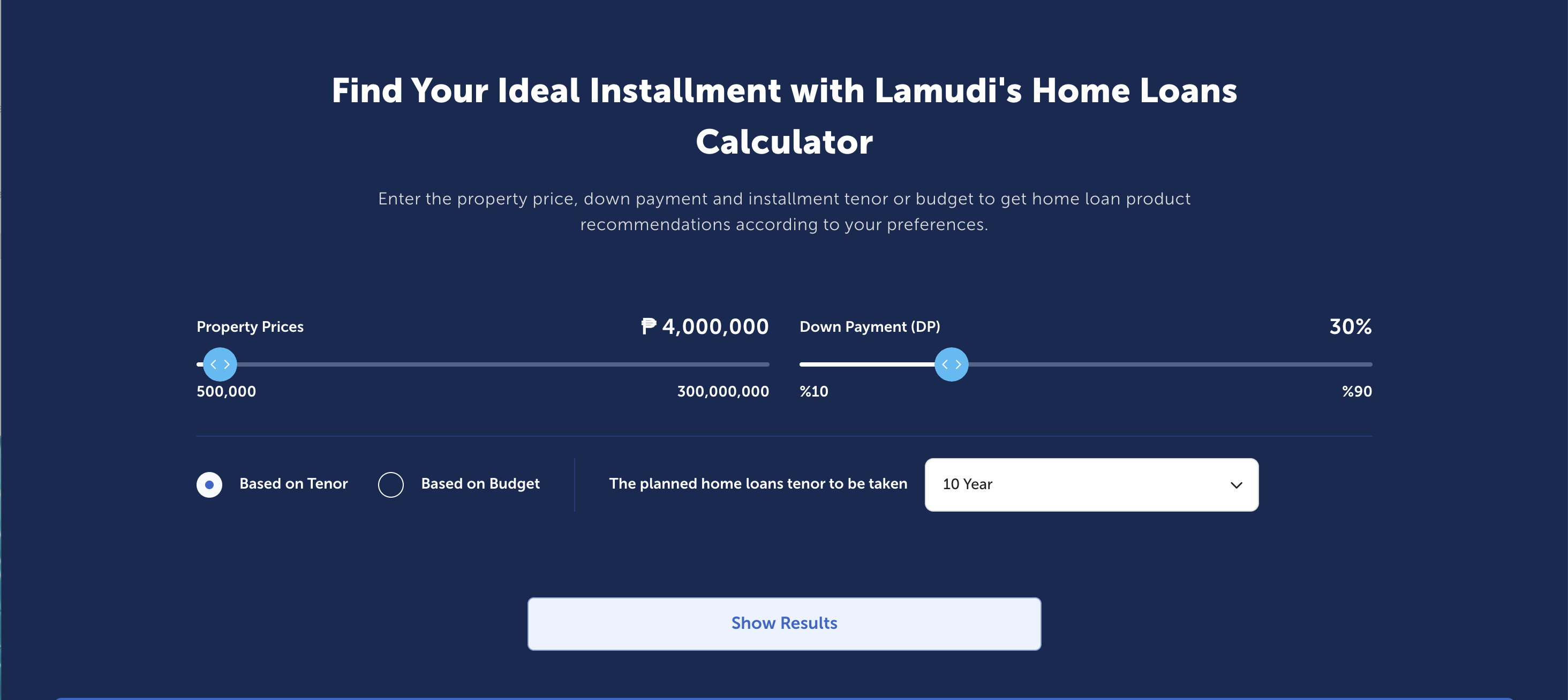
Start with our Home Loan Calculator. This powerful tool lets you estimate your monthly amortizations, explore different loan amounts, and compare repayment terms. By inputting your income, budget, and preferred loan tenor, you can see exactly how much your monthly payment would be for each loan type. It’s a practical way to plan ahead and make sure your housing loan fits your financial situation without stretching your budget.
Beyond numbers, our platform provides personalized home loan recommendations. We take your financial profile, property preference, and long-term goals into account, then suggest options tailored to your needs.
You can also compare multiple loan options side by side. See the differences in interest rates, repayment terms, and fees between Pag-IBIG, bank, and in-house financing. This makes it easier to weigh pros and cons and choose the option that balances affordability, flexibility, and speed. Knowledge is power, and understanding your options upfront saves you from surprises later.
Of course, numbers alone aren’t always enough. That’s why our home loan advisors are available for free consultations. They can walk you through the entire process, from preparing documents to understanding fees, pre-approvals, and repayment schedules. With multi-platform access, you can connect via phone, email, or online chat so that it is convenient for you no matter where you are.
Don’t leave your homeownership dream to chance. Start with our calculator, get personalized recommendations, compare your options, and speak with an expert today. With the right tools and guidance, the journey to your dream home becomes clear, manageable, and within reach.
