Check out more of our news
Can Freelancers Apply for a Home Loan in the Philippines?
February 24, 2026 | Read Time 4 minutes

Freelancers can apply for a home loan in the Philippines, whether through banks or government lenders like Pag-IBIG Fund, but it isn’t as straightforward as for traditionally employed applicants. Lenders need convincing proof of income and financial stability, and freelancers often face extra documentation requirements or stricter scrutiny of their cash flows.
What Proof of Income Do Freelancers Need for a Home Loan?
Since freelancers typically lack payslips or employer certificates, Philippine lenders and Pag‑IBIG accept alternative proofs, such as:
- Income Tax Returns (ITR) filed with the BIR — the most solid evidence of income
- Bank statements showing consistent deposits over 6–12 months
- Client contracts or engagement letters
- Certificates of earnings (e.g., from online platforms)
- Affidavits of income or invoices/receipts from clients
💡IDEAL Tip: Gather all your documents early to make your home loan application smoother. For a complete reference, check out our Home Loan Requirements Checklist to see exactly what lenders expect from freelancers like you. |
Is It Harder for Freelancers to Get a Home Loan?
Freelance income can be variable, which makes risk assessment tougher for lenders compared with salaried applicants. Banks and lenders will often:
- Look for consistency in revenue over time
- Require more documentation (e.g., ITRs, contracts, audited statements for self‑employed)
- Assess your average monthly income to make sure loan payments don’t exceed a safe percentage of your earnings
This means freelancers need to prove they have reliable cash flow, not just sporadic gigs. Lack of formal employment doesn’t disqualify you, but proof quality matters.
How to Strengthen Your Home Loan Application as a Freelancer
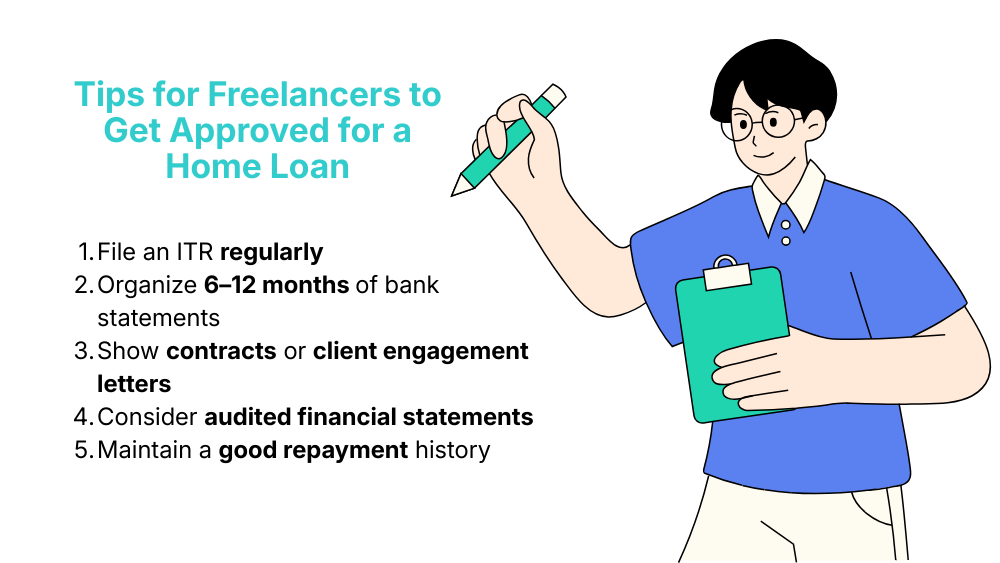
To boost approval chances:
- File an ITR regularly. This is often the strongest proof of income for self‑employed applicants.
- Organize 6–12 months of bank statements with clear income deposits.
- Show contracts or client engagement letters that demonstrate ongoing work stability.
- Consider audited financial statements if you’re registered as a business.
- Maintain a good repayment history and work on your credit score.
💡IDEAL Tip: Keep your credit profile in good shape! Learn more about your Credit Score and find practical steps to strengthen your credit and improve your chances of approval |
What Are Alternative Home Loan Options for Freelancers?
If a direct home loan seems challenging, you can:
Apply with a co‑borrower
Bringing a co-borrower, like your spouse, partner, or family member with a stable income, can significantly improve your loan approval chances. Banks look at the combined income and repayment capacity, which helps offset the variability of freelance earnings.
Put down a higher downpayment
Offering a higher downpayment reduces the loan amount and signals financial stability to lenders. This can be a powerful strategy for freelancers with irregular income. Similarly, choosing a shorter loan term may improve your approval chances since the bank sees a lower risk.
Get Your Home Loan Approved with IDEAL
If you’re a freelancer looking to secure a home loan in the Philippines, IDEAL Home Loan can guide you every step of the way. We help freelancers evaluate options and organize all required documents to strengthen your application. Our team also connects you with different banks that understand self-employed income patterns, so you can successfully get a home loan without unnecessary delays or stress.