Check out more of our news
Pag-IBIG vs Bank Housing Loan for OFWs: Which Is Better?
February 19, 2026 | Read Time 15 minutes

What is a Pag-IBIG Housing Loan?
Pag-IBIG loans are government-backed and designed to be OFW-friendly, offering lower interest rates and longer repayment terms that make them ideal for first-time buyers. However, strict contribution requirements and a maximum loan limit can limit your options if you are planning to buy a higher-end or more expensive property..
Key features of Pag-IBIG housing loans:
1. Membership requirement
At least 24 monthly Pag-IBIG contributions (not necessarily consecutive) for loan eligibility.
2. Interest repricing periods
Borrowers choose repricing periods (1, 3, 5, 10 years, up to 30 years) that determine when interest rates are reset
3. Loan maximum
Up to 30 years, making monthly amortization potentially more affordable
4. Down Payment & LTV
Up to 95% loan‑to‑value (LTV) for properties under ₱2.5M and 90% for higher‑value properties.
5. Interest structure
For 2026, OFWs can get a 3% subsidized interest rate for the first five years under the Expanded 4PH Program for socialized housing. For non-socialized loans up to ₱1.8 million, Pag-IBIG also offers promotional rates as low as 4.5%.
OFWs can qualify for these programs regardless of income, but the subsidized rates may be limited by application slots. If you don’t qualify for the promos, regular Pag-IBIG rates still apply
Pag-IBIG loans are often more accessible to OFWs because approvals are based more on contribution longevity and capacityto pay than strict credit scoring common in banks. |
Bank Home Loans
Bank housing loans are offered by commercial banks. Unlike Pag-IBIG, banks operate privately and consider each borrower’s credit history, income stability, debt-to-income ratio, and overall credit risk profile.
Type characteristics of bank housing loans:
1. Interest rates
Often competitive. Sometimes lower in the short term but subject to repricing or adjustment as market rates change.
2. Loan amounts
Banks can offer significantly higher loan ceilings than Pag-IBIG, depending on income and property value.
3.Loan term
Often up to 20-25 years, though some banks offer up to 30 years on select products
4. Eligibility
Based on income stability, credit rating, existing debt, age, and employment tenure
For OFWs, bank loans may require more documentation and prove tougher if income streams are non‑traditional, contractual, or inconsistently documented. |
Pag-IBIG vs Bank Housing Loans
Feature | Pag‑IBIG Housing Loan | Bank Housing Loan |
Interest Rate Range | ~ 5.75% – 9.75% | ~6.15% – 9.50% |
Maximum Loan Amount | Up to ₱6,000,000 | Varies (often above ₱6M depending on income and bank policies) |
Loan Term | Up to 30 years | Typically 20–25 years (some up to 30) |
Down Payment | 5–10% (depending on LTV) | Usually 20% or higher |
Approval Time | Weeks to months | 2–6 weeks |
Eligibility Barrier | Moderate | Higher (income proof, credit score) |
Example
To illustrate the difference between the two, let us consider:
Property price: ₱5,000,000
Down payment: 10%
Loan amount: ₱4,500,000
Term: 20 years (240 months)
Interest assumption (Regular rates):
- Pag‑IBIG 3-Year Fixing: 6.25%
- Bank fixed rate at ~7.25% (common mid‑range)
Note: Exact monthly amortization can vary by repricing term chosen and specific bank rate.
Loan Type | Interest Rate | Monthly Amortization |
Pag-IBIG | 6.25% | ~₱33,600 |
Bank | ~7.25% | ~₱36,800 |
Even with similar loan amounts, Pag‑IBIG’s lower rate and longer potential terms typically result in lower monthly payments which can be a crucial consideration for OFWs managing remittances and family budgets.
To get a better estimate for your bank home loan inquiry, try our IDEAL Home Loan calculator here |
Approval chances and timelines for OFWs
When it comes to securing a home loan as an OFW, approval probability can vary widely depending on whether you go through Pag-IBIG or a bank. Pag-IBIG loans generally have a higher chance of approval for those who meet the basic membership, contribution, and income or employment.
Bank housing loans, on the other hand, have more variable approval chances. Each bank applies its own credit risk policies, carefully checks income documentation, and often considers your employment stability. However, OFWs who maintain a solid remittance history and well-documented income statements can still qualify for a bank loan, sometimes even for higher-value properties.
Approval Timeline
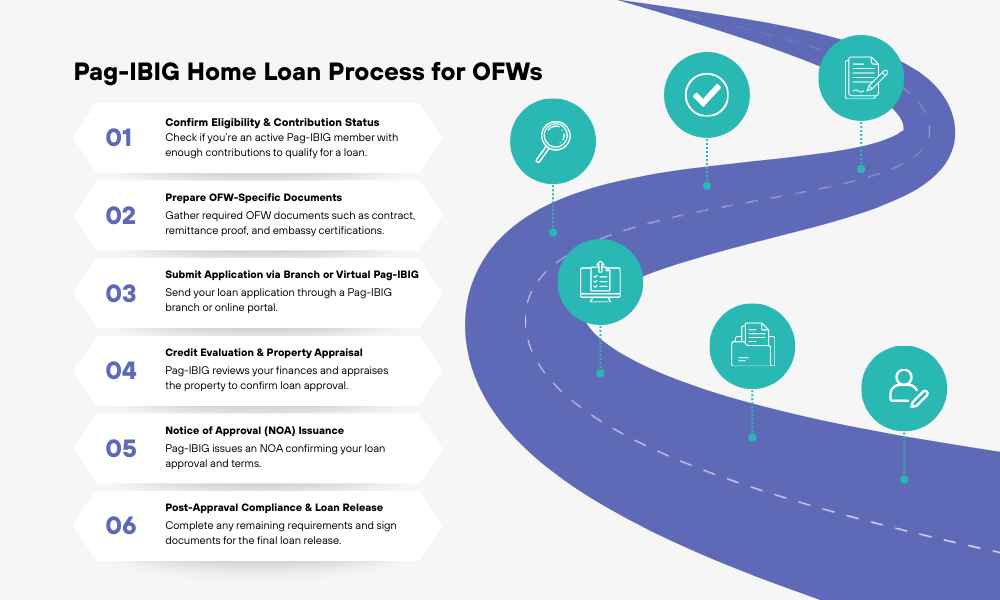
Pag-IBIG Home Loan Process for OFWs
The loan process for OFWs typically takes 6–12 weeks, and may take longer if documents are incomplete. Here’s the usual step-by-step flow:
- Confirm Eligibility & Contribution Status
- Prepare OFW-Specific Documents
- Submit Application via Branch or Virtual Pag-IBIG
- Credit Evaluation & Property Appraisal
- Notice of Approval (NOA) Issuance
- Post-Appraval Compliance & Loan Release
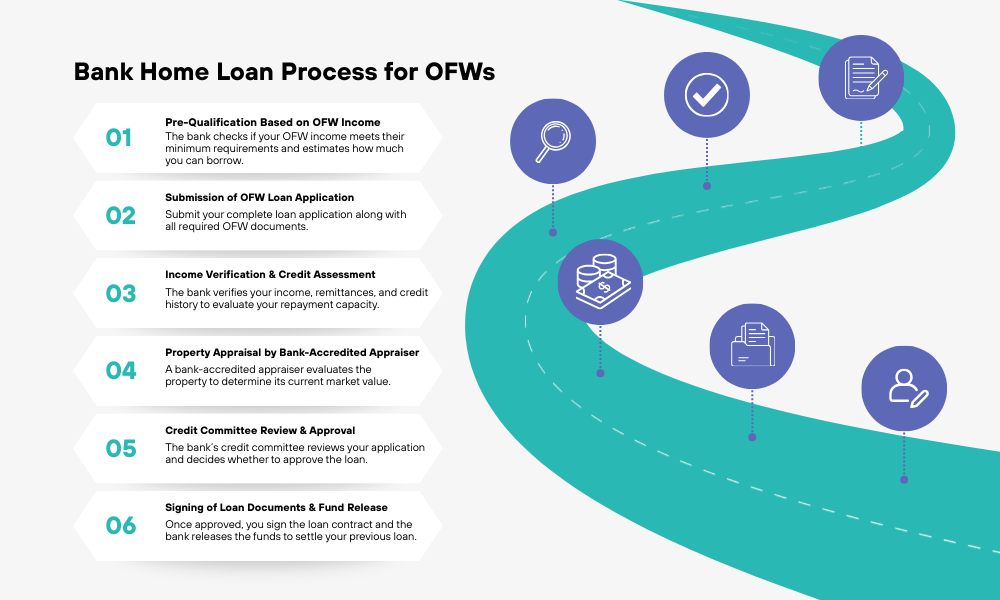
Bank Home Loan Process for OFWs
Assuming complete documentation, your home loan application from banks can take up to 2-4 weeks. Below is the typical process you can expect:
- Pre-Qualification Based on OFW Income
- Submission of OFW Loan Application
- Income Verification & Credit Assessment
- Property Appraisal by Bank-Accredited Appraiser
- Credit Committee Review & Approval
- Signing of Loan Documents & Fund Release
Pros and Cons of Loaning from Pag-IBIG vs Banks for OFWs
Pag-IBIG Housing Loan
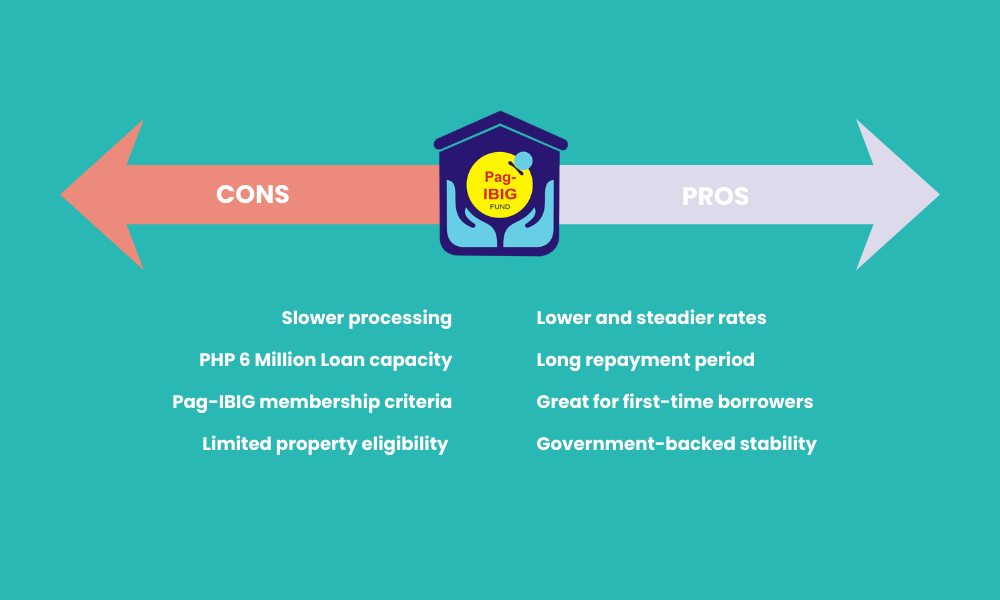
Why OFWs Might Love Pag-IBIG Housing Loan (Pros):
Lower & more predictable interest
Pag-IBIG loans often come with lower fixed interest rates compared to long-term bank pricing, especially under certain housing programs. This means more predictable monthly payments that don’t ride the market rollercoaster.
Longer repayment period
You can spread payments up to 30 years, which is great for OFWs wanting smaller monthly amortizations and better cash flow while supporting family back home.
Great for first-time borrowers
Since Pag-IBIG focuses on contributions and membership rather than credit scores, OFWs who have been consistent with their contributions can have a better shot even without a long credit history.
Government-backed stability
Being a government agency means Pag-IBIG loans come with less risk of sudden policy changes compared to private banks.
Lower fees can mean more take-home savings
Generally, Pag-IBIG’s processing and appraisal fees are lower than banks’ which keeps upfront costs lighter for first-time OFW buyers.
Where it gets challenging (Cons)
Slower processing can test your patience
Compared to bank housing loans that may be approved within weeks, Pag-IBIG housing loans often take several months to process. Delays are common when documentation is incomplete, which can be challenging for OFWs who are working against strict property turnover or reservation deadlines.
Loan cap may limit property choices
While sufficient for many buyers, Pag-IBIG’s maximum loanable amount of ₱6 million may fall short for OFWs looking to purchase high-value homes, premium condominiums, or prime location properties.
Strict membership and contribution requirements
OFWs must maintain active Pag-IBIG membership and regular contributions to qualify. New OFWs or those with gaps in contributions may need to pay lump-sum remittances which can delay the loan application process.
Limited property eligibility under Pag-IBIG rules
Not all properties qualify for Pag-IBIG housing loan financing. Homes and condominium projects must meet Pag-IBIG’s accreditation and appraisal standards, potentially narrowing the pool of eligible properties for OFW buyers.
Bank Housing Loan
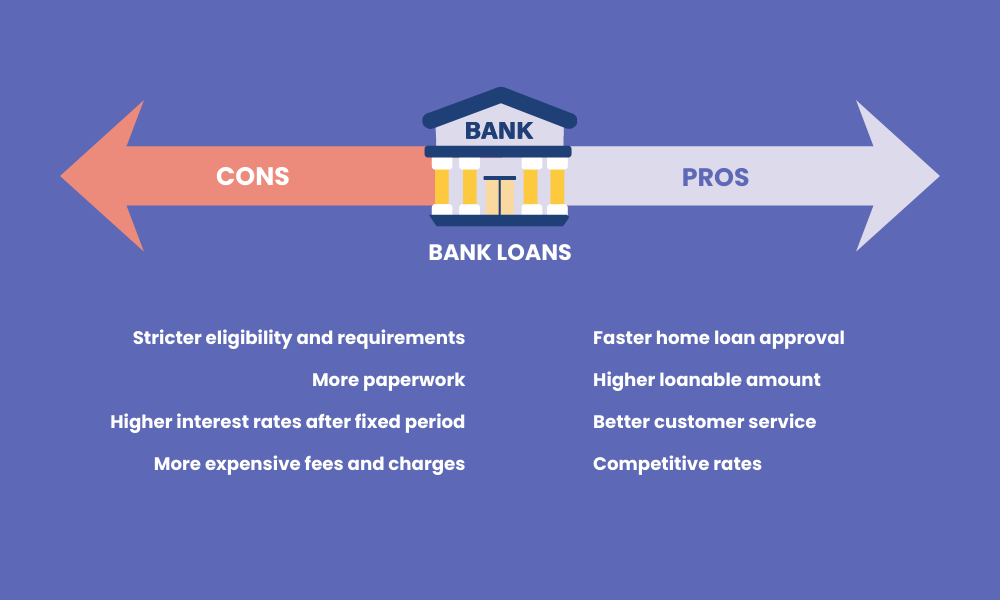
Why OFWs Might Choose Bank Home Loan (Pros):
Faster home loan approval for OFWs
Compared to Pag-IBIG, bank housing loans in the Philippines are processed much faster, often within a few weeks when documents are complete. This makes banks ideal for OFWs who need quick property closings or fast turnover timelines.
Higher loanable amounts for premium properties
Banks typically offer higher housing loan limits than Pag-IBIG’s ₱6M cap, allowing OFWs to purchase high-value homes, larger house-and-lot packages, or upscale condominiums in prime locations.
Better customer service
If you have a relationship with the bank (salary account, existing loans, etc.), you may get better service and easier coordination. Banks tend to prioritize clients they know, which can make the process feel faster and more personalized, especially when you need updates, document assistance, or help with loan concerns.
Competitive introductory interest rates
Many bank home loans offer lower fixed interest rates during the initial 3-5 years, which can be advantageous for OFWs planning to refinance, sell, or upgrade properties later on.
Where it gets challenging (Cons):
Stricter income and document requirements
Banks apply tighter credit risk assessments, carefully reviewing employment contracts, income stability, remittance records, credit history, and debt-to-income ratios. OFWs with short-term contracts or irregular income may find approval more difficult.
More paperwork
In addition to the standard requirements, banks may ask for extra documents such as contract verification, embassy certifications, and proof of remittances. Gathering and processing these additional papers can take more time, which may slow down approval and prolong the loan process.
Interest rates may increase after the fixed period
While introductory rates can be attractive, bank housing loan interest rates often reset after the fixed term, potentially raising monthly amortizations if market rates increase.
More expensive fees and charges
Banks can also be more expensive up front because of the many fees that come with a bank home loan. Aside from the interest rate, you may need to pay a processing fee, appraisal fee, documentary stamps, and legal fees among others. These costs can add up quickly and sometimes reach tens of thousands of pesos, especially for larger loan amounts.
Frequently Asked Questions
Which home loan is easier for OFWs to get approved: Pag-IBIG or Banks
For most OFWs, Pag-IBIG is generally easier to qualify for. As long as you meet the minimum contribution requirement and age limits, Pag-IBIG tends to be more lenient with overseas income documents. Banks usually apply stricter credit checks, require higher income thresholds, and may favor OFWs from specific countries or employers.
How much can OFWs borrow from Pag-IBIG vs banks?
Pag-IBIG allows loans of up to ₱6 million. Banks can offer higher loan amounts, depending on your income, credit profile, and property value—making banks more suitable for higher-priced properties.
Which option is better if my income is irregular?
Pag-IBIG is usually more forgiving with contract-based or variable OFW income, while banks prefer stable, high, and long-term income records.
Which home loan is better overall for OFWs?
It depends on your priority:
- Choose Pag-IBIG if you want lower rates, longer terms, and easier qualification
- Choose banks if you need faster approval, higher loan amounts, or premium properties
Many OFWs start with a bank loan for speed, then refinance to Pag-IBIG later to reduce long-term costs
Are there fees for switching or combining loans?
Yes, there are usually fees such as appraisal, processing, notarial, and legal fees. Some banks also charge prepayment penalties or exit fees from your current loan.
Which option is better for buying a high-value or premium property?
Banks. Pag-IBIG has a ₱6M loan cap, which may not be enough for premium condos or house-and-lot properties. Banks can approve much higher loan amounts depending on income and property value.
Do I need to be in the Philippines to apply for a housing loan?
No. Both Pag-IBIG and banks allow OFW applications through:
- Special Power of Attorney (SPA)
- Online or virtual submission (varies by lender)
- Authorized representatives in the Philippines