Check out more of our news
Home Loan Interest Rates in the Philippines Explained (Fixed vs Variable)
February 19, 2026 | Read Time 10 minutes

Understanding Home Loan Interest Rates
Home loans are one of the biggest financial commitments most people will ever make. Your interest rate affects how much you pay each month and how much the loan costs over time. Choosing the right rate type and knowing how it changes can save you tens of thousands of pesos and give you peace of mind.
What Are Fixed, Variable/Floating, and Hybrid Interest Rate?
When you take out a home loan, part of what you pay each month goes toward the interest the bank or Pag-IBIG charges you for lending you money. That interest rate can behave differently depending on the type you choose.
Fixed Rate
A fixed rate means the interest percentage stays the same for a set period of time. If you choose a three-year fixed rate at 6.5%, that number will not change for those three years. Your monthly payment based on interest does not go up or down during that fixed period.
Home loans often have fixed rates for 1,2,3,5, or even 10 years. After that fixed period ends, the loan goes into repricing or becomes variable unless you negotiate a new fixed rate with your lender.
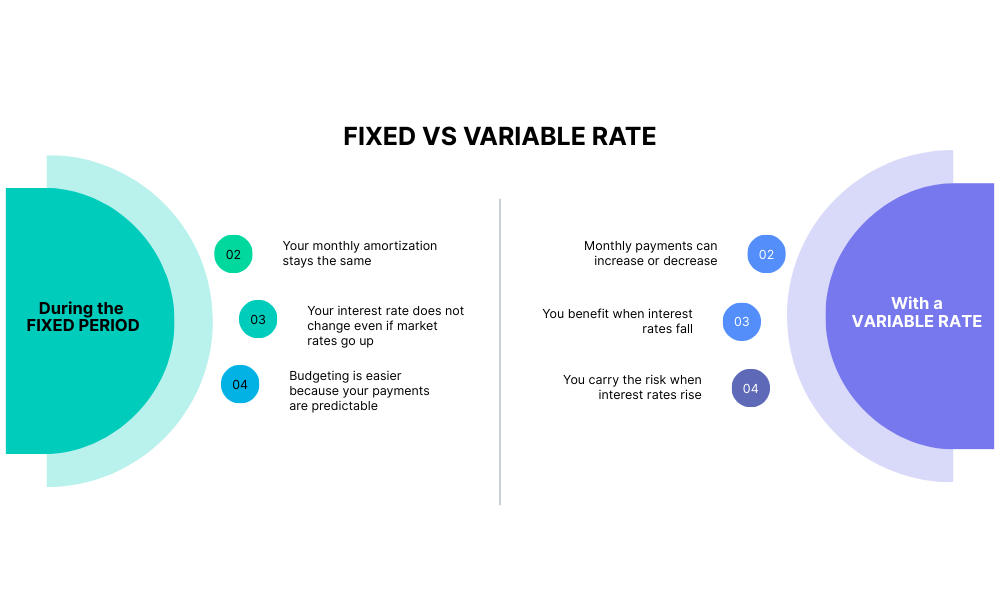
During the fixed period:
- Your monthly amortization stays the same
- Your interest rate does not change even if market rates go up
- Budgeting is easier because your payments are predictable
After the fixed period ends, your loan will go through repricing. The bank will set a new interest rate based on current market conditions and their internal policies.
Variable or Floating Rate
A variable or floating rate changes over time. Instead of staying fixed, the interest rate moves based on changes in the bank’s benchmark or reference rate.
In the Philippines, banks usually base variable rates on internal reference rates or market indicators that reflect the overall interest rate environment. The total rate is usually made up of two parts:
- A reference or benchmark rate
- A spread added by the bank
If the reference rate goes up, your home loan interest rate goes up. If it goes down, your rate may also go down.
With a variable rate:
- Monthly payments can increase or decrease
- You benefit when interest rates fall
- You carry the risk when interest rates rise
Variable rates are more common after the fixed period ends, although some loans start as variable from the beginning.
Hybrid Interest Rate
A hybrid rate combines fixed and variable features.
Here in the Philippines, this usually means your home loan starts with a fixed rate for a certain number of years and then shifts to a variable rate afterward. For example, a loan might be fixed for three years and then reprice annually.
Hybrid structures are very common in bank home loans and are designed to give borrowers early stability while allowing flexibility later.
How Home Loan Rates Are Set in the Philippines
Home loan interest rates in the Philippines are influenced by both the broader economy and each lender’s internal policies.
Market and Economic Factors
Interest rates in the country are affected by:
- Bangko Sentral ng Pilipinas policy rates
- Inflation levels
- Overall economic conditions
- Liquidity in the banking system
When the BSP adjusts policy rates, banks often follow by adjusting their own lending rates, especially for variable loans and repricing.
Bank Reference Rates and Spreads
Partner banks typically use internal reference rates as the basis for their home loan pricing. On top of that reference rate, they add a spread.
The spread depends on:
- Your credit profile
- Loan amount and loan term
- Risk assessment
- Bank funding costs
This is why two borrowers applying at the same time can be offered different rates by the same bank.
Promotional Rates
Banks often offer promotional fixed rates for limited periods. These may apply to:
- New home loans
- Refinancing
- Selected projects or developers
Promotional rates can be attractive, but it is important to understand what happens after the promo or fixed period ends.
To make it easier, you can check out current bank promos and find the best interest rate for your profile on our IDEAL Home Loan page. This way, you can see which options fit your budget and long-term plans before applying. |
Pros and Cons of Fixed vs Variable Rates
There is no universally best interest rate type. The right choice depends on your priorities and comfort level.
Fixed Rate
Advantages | Disadvantages |
|
|
Variable Rate
Advantages | Disadvantages |
|
|
How Interest Rate Changes Affect Monthly Payments
When banks and Pag-IBIG compute your home loan payments, they don’t guess the amount. They follow a standard amortization formula that spreads your loan balance, interest, and repayment period evenly across the life of the loan.
Let’s look at a simple example:
Imagine you are buying a home and you take out a home loan with the following terms:
Assumptions (Same for Both Scenarios)
- Home loan amount: PHP 3,000,000
- Loan term: 20 years (240 months)
- Location: Philippines
- Purpose: Residential home loan
The loan amount and term stay the same.
Only the interest rate structure changes.
Fixed Rate
3-Year Fixed Rate at 6.75% per Year
How the Monthly Payment Is Computed
Banks start by converting the annual interest rate into a monthly rate.
- Annual rate: 6.75%
- Monthly rate: 6.75% ÷ 12 = 0.5625% per month
That monthly rate is applied to the loan balance over 240 months.
Using the standard home loan amortization computation, the monthly payment comes out to:
Around PHP 22,800 per month
What This Looks Like in Real Life (Years 1 to 3)
For the first three years:
- You pay PHP 22,800 every month
- The amount does not change
- Your budget stays predictable
Even if interest rates in the Philippines move up or down during those three years, your monthly payment stays exactly the same. This stability is why fixed rates are popular with first-time homebuyers.
What Happens After Year 3 (Repricing)
Once the fixed period ends, the bank reviews your rate based on prevailing market conditions.
Here’s how the numbers can change:
- If the rate increases to 8.25%, the recomputed monthly payment becomes around PHP 25,200
- If the rate drops to 6.25%, the monthly payment goes down to around PHP 21,900
The important part is this:
You had three full years of stable payments to prepare before any adjustment happened.
Variable Rate
Starting Rate at 7.0% per Year
Now let’s use the same loan, but with a variable interest rate.
How the First Payment Is Computed
- Annual rate: 7.0%
- Monthly rate: 7.0% ÷ 12 = 0.5833% per month
Applied over 240 months, this results in an estimated monthly payment of:
Around PHP 23,300 per month
At the beginning, this feels close to the fixed-rate payment.
When Interest Rates Go Up
If market rates in the Philippines rise and your variable rate adjusts to 8.5%:
- The loan is recomputed using the new rate
- Your monthly payment increases to around PHP 26,000
That extra amount goes mostly toward interest, which means higher total loan cost over time.
When Interest Rates Go Down
If rates fall and your variable rate drops to 6.0%:
- The recomputed monthly payment becomes around PHP 21,500
You save on interest and get more breathing room in your budget
Example
Rate Lock Periods and Repricing
A rate lock period is the length of time your interest rate stays unchanged.
For fixed rate loans, this is the agreed fixing period. For example, a 5-year fixed rate stays the same for 5 years.
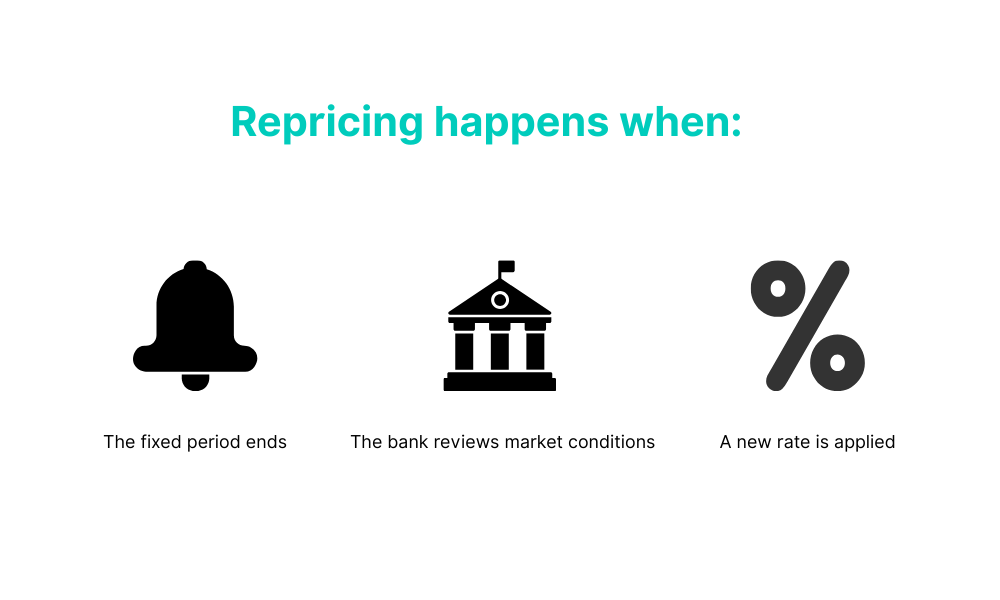
Repricing is normal and expected. What matters is knowing when it happens and how it affects your monthly payments.
Tips for Choosing the Right Rate Type
If You Want Predictability
Choose a fixed rate. This is ideal if you value stability and want to avoid surprises in your monthly payments.
If You Can Handle Some Risk
A variable rate may work if you have buffer income and are comfortable with possible increases.
If You Want Balance
A hybrid option gives you stability at the start and flexibility later.
If Budget Is Tight
Consider Pag-IBIG home loans, especially if you qualify for lower income brackets.
Frequently Asked Questions
How often do banks review variable rates?
Most banks review variable or floating rates once a year, but this can vary depending on the lender and your loan agreement. Always check your contract so you know when your rate can change.
What does repricing mean?
Repricing happens when your fixed interest period ends and the bank adjusts your rate based on current market conditions and their internal pricing. After repricing, your monthly payment may go up or down depending on where interest rates are at that time.
What happens if I do nothing when my fixed period ends?
If your fixed period ends and you do not choose to refix or change your terms, most banks will automatically move your loan to a variable or repricing structure based on current rates and your contract terms. This can change your monthly payments, so planning ahead is helpful.
Can my monthly payment go down if interest rates fall?
Yes. If you are on a variable or repriced rate and market interest rates decline, your bank may reduce your interest rate on the loan when they review it. This can lead to lower monthly payments. If you are in a fixed period, your payment stays the same until that period ends.
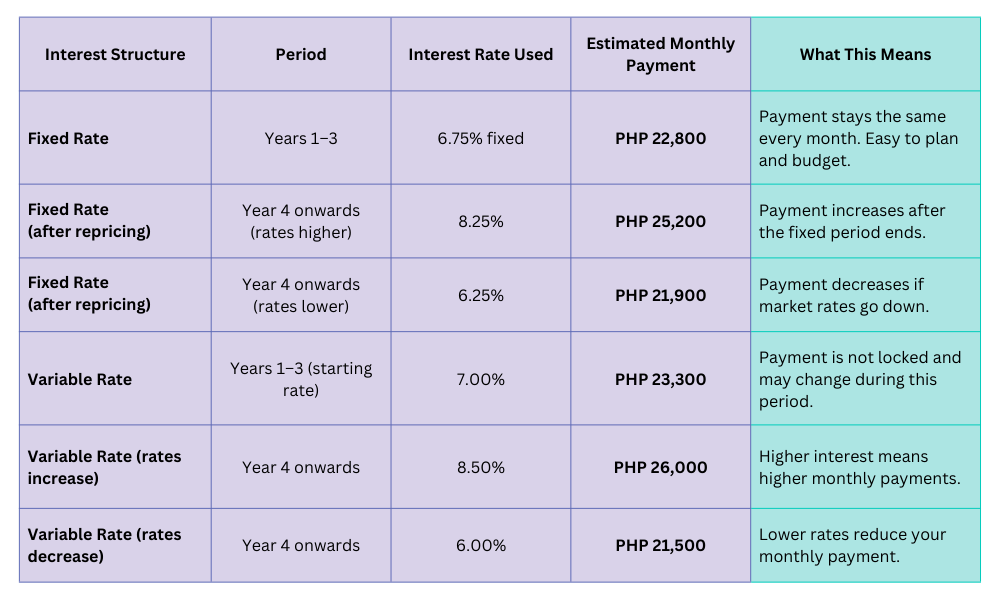
Fixed Rate | Years 1–3 | 6.75% fixed | PHP 22,800 | Payment stays the same every month. Easy to plan and budget. |
Fixed Rate | Year 4 onwards (rates higher) | 8.25% | PHP 25,200 | Payment increases after the fixed period ends. |
Fixed Rate | Year 4 onwards (rates lower) | 6.25% | PHP 21,900 | Payment decreases if market rates go down. |
Variable Rate | Years 1–3 (starting rate) | 7.0% | PHP 23,300 | Payment is not locked and may change during this period. |
Variable Rate (rates increase) | Year 4 onwards | 8.5% | PHP 26,000 | Higher interest means higher monthly payments. |
Variable Rate (rates decrease) | Year 4 onwards | 6.0% | PHP 21,500 | Lower rates reduce your monthly payment. |
